
A Day Trip to Meaux: Cheese Capital of the Île-de-France

Paris has so much to offer it’s tempting never to go beyond the Périphérique. Which is a shame because the Île-de-France region is full of historic towns, regional parks, lakes, forests and châteaux. If you have been to Paris several times already, or are visiting for an extended period, it’s well worth exploring further afield. And with a 5-zone Navigo it can be done completely free!
One town that repays a day trip is Meaux, famous for its Brie cheese, and just 25 minutes from Paris on the train. But apart from Brie, there is a lot more to see in Meaux. A Celtic tribe called the Meldis were living here on the banks of the River Marne in the time of Julius Caesar, and under the Roman Empire it became a thriving Gallo-Romano town. No one is quite sure when it first became the seat of power for a bishop but it might have been some time in the 6th or 7th century.
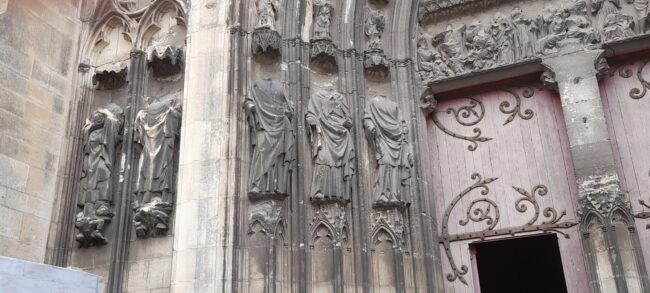
Decapitated saints on the south door of the cathedral in Meaux. Photo credit: Pat Hallam
Today, the Cathédrale du Saint Etienne still dominates the town and is easily visible from the train station. It forms the centerpiece of one of the best-preserved episcopal quarters in Europe. Originally begun around 1170 on the site of an earlier church dedicated to St Stephen, the first cathedral was structurally unsound and had to be virtually rebuilt in the 13th century, in the new Gothic style. The interior is flooded with light as the pillars of the nave soar towards the roof. But the cathedral at Meaux was a late addition to a long tradition of monasticism in the Brie region. Right back in the 7th and 8th centuries, English royal and aristocratic families were sending their daughters here to be educated, several of whom went on to become abbesses and run their own convents. Look out for the statues of saints surrounding the south door. Every single one is missing its head – not erosion over time but deliberate decapitation. This was frequently carried out by revolutionaries who mistakenly believed the statues represented kings.
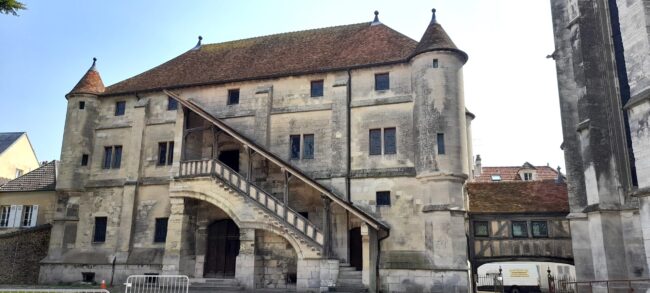
The chapter house in Meaux. Photo credit: Pat Hallam
The town center still flanks the cathedral along its principal street, the Rue Général Leclerc, but on the other side stands a well-preserved complex of episcopal buildings, notably the chapter house and bishop’s palace. The bishop’s staff, the canons, lived in houses forming a horseshoe (the streets still exist: Rue Bossuet on the western side and Rue Notre Dame on the eastern) and the whole formed a private enclave that emphasized the Church’s predominance in medieval society. The chapter house was the equivalent of a modern council chamber: here, the bishop and canons met to discuss administrative and financial matters affecting the cathedral. They are usually built in stone as an annexe to the cathedral so Meaux’s is unusual in being a timber-framed building standing apart. It dates from the 13th century and entry is upstairs via a staircase, while an enclosed gallery connects it to the cathedral across a gateway to the public street.
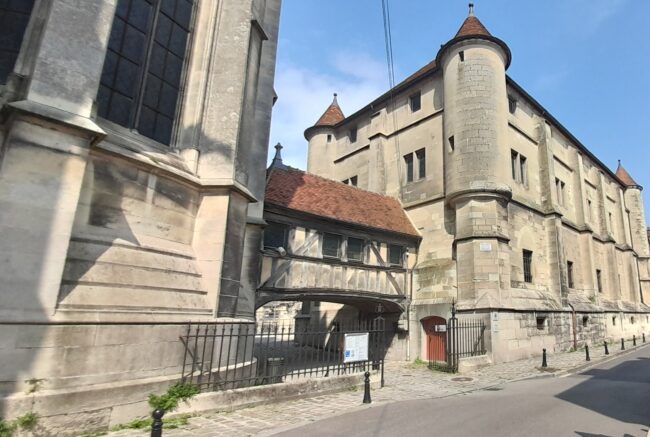
Rear of the Chapter House in Meaux. Photo credit: Pat Hallam
The Bishop’s Palace, a much grander building in stone, is a hundred or so years older, begun in around 1170. Before the chapter house was built, this is where the canons would do business and it also served as a church court. The tower is a Renaissance addition from the 16th century, while the apse at one end belongs to a two-storeyed chapel and the pillared arcade along its northern side overlooks the charming Jardin Bossuet. Since 1927 it has belonged to the town of Meaux and houses the municipal art gallery, with a collection of paintings and sculptures dating from the 16th to the 19th centuries.
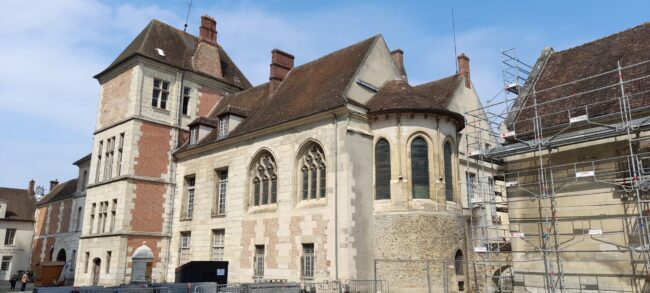
The Bishop’s Palace. Photo credit: Pat Hallam
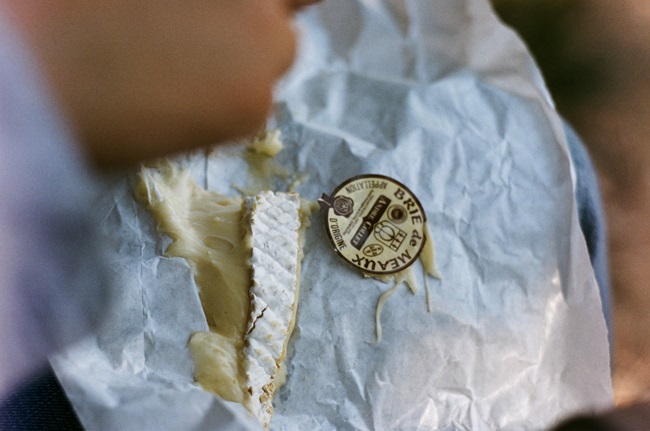
The Palace was extended in 1586 along the western side of the square to form the Brézés wing. Today, it houses the tourism office and the Maison de Brie – a small museum dedicated to the production and heritage of one of Meaux’s most famous exports: Brie cheese (the other is mustard). Charlemagne ate Brie way back in 774, liking it so much he ordered it to be regularly delivered to his capital at Aix-la-Chapelle. It features throughout French history: the pastry delicacy known as bouchées de la reine was invented for Marie Leszczynska, the wife of Louis XV, and originally called bouchées de Brie, and the fate of Louis XVI was sealed when he paused his flight from Paris at Varennes by partaking of a snack of Brie and red wine (thus giving his pursuers enough time to catch up).
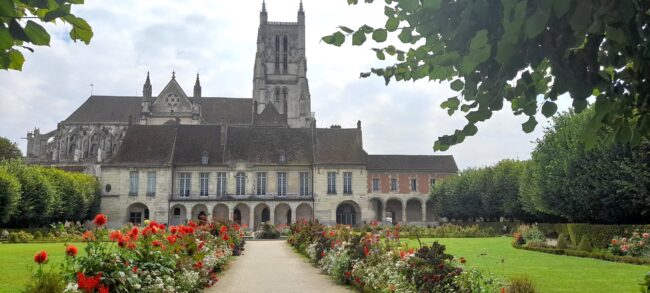
The Jardin Bossuet, behind the Bishop’s Palace. Photo credit: Pat Hallam
True Brie has AOP status confirming that it is only made from raw cow’s milk from cows pastured in a tightly delimited area. Since 1991 a guild of Brie cheesemakers called La Confrerie des Compagnons du Brie de Meaux has ensured that production adheres to the regulations and runs an annual competition to find the best Brie. They dress in ceremonial costume including a faintly comical hat of cream velvet in the shape of a wheel of Brie.
At weekends the museum puts on tastings of the three versions of Brie de Meaux: classic, Brie à la moutarde, and Brie noir. The Brie à la moutarde – combining the cheese with a layer of Meaux grain mustard – is delicious. Brie noir – hmm, maybe not so much. The cheese is dehydrated until it turns a dark brown, to the point that eating it packs a pure umami punch. A tiny amount goes a long, long way. It is definitely an acquired taste.
And if this isn’t enough to satisfy your cheese cravings, on the outskirts of town you can visit a working dairy farm at Saint Faron that manufactures AOP Brie de Meaux and Brie de Melun. It’s best to go in the morning when the cheesemakers start on the first milk of the day.
Stepping out of the museum, an archway to the left leads into the pretty Jardin Bossuet. Bossuet was Bishop of Meaux 1681-1704 and a renowned theologian, but despite the garden’s name, it was actually laid out in 1670 for his predecessor Bishop Séguier, who employed André le Nôtre, garden designer at Versailles and Vaux-le-Vicomte. It is laid out in classic French parterre style but eco-friendly wildflower planting in some of the beds provides a riot of color as well as attracting bees and butterflies. Roses are prominent, including the Bossuet-Aigle de Meaux, a bright mauve hybrid tea rose with an intoxicating scent. Around the sides, tree-planted allées are a welcome shady retreat on hot days. The rear of the garden backs on to the ramparts and you can still see a small stone pavilion where Bossuet used to work.
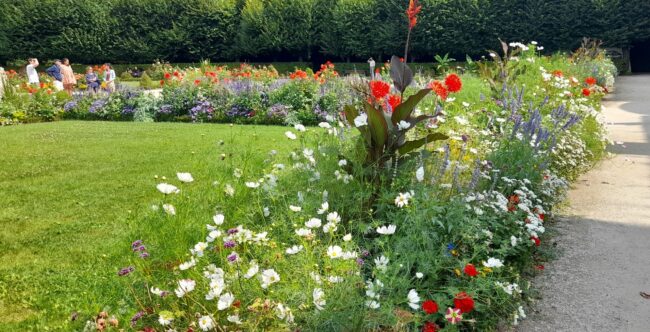
Wild flowers in the Jardin Bossuet, Meaux. Photo credit: Pat Hallam
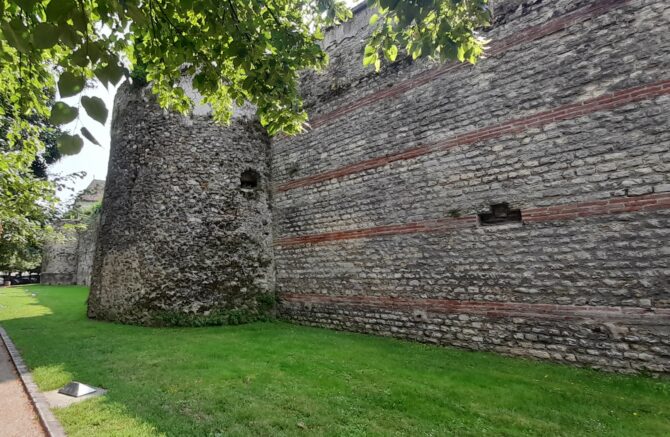
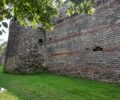
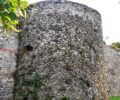
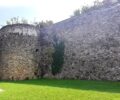
There is no direct access to the ramparts from the garden but that doesn’t matter as they can be reached via the Rue Notre Dame, under the connecting gallery between chapter house and cathedral. The original fortifications were built in the 3rd century by the Romans to ward off barbarian attacks and there are still vestiges of these, but the current remains date mainly from the 15th century. Even now they are pretty imposing.
A curtain wall runs for several hundred meters along the Boulevard Jean Rose, still at full height. Every few meters or so round towers offer extra defense. Bishop Séguier planted a suspended garden along the top and again, parts of this still exist although wildly overgrown. The proliferation of trees and other penetrating vegetation, as well as the general passage of centuries, has severely weakened the wall and it is not possible to walk along the top of the ramparts because of their dangerous condition. Fortunately, they have been the lucky recipient of funds from the Loto du Patrimoine (proceeds from the national lotto dedicated to restoring France’s built heritage). Since 2022 work has been underway to stabilize the wall and restore the suspended garden. By 2026 it should once again be possible to gain access to the ramparts.
But Meaux is notable not just for its medieval history. About a 15-minute walk from the town center is the Musée de la Grande Guerre, Europe’s largest museum dedicated to the First World War. Situated as it is on the River Marne, Meaux was very much on the frontline in the early days of the war. Famously, the French government requisitioned all the taxis in Paris to transport enough troops to the battlefront for the Battle of the Marne in September 1914. The museum houses over 70,000 attractively displayed artifacts including tent encampments, early airplanes and vintage vehicles, even prosthetic arms used to replace amputated limbs. Contemporary photographs, postcards and film footage portray the day-to-day lives of soldiers and conditions in the trenches and there are regular exhibitions. It’s a wonderful day out for families and people of any age.
If you don’t fancy a war museum, Meaux itself has maximized its position on the Marne with a pleasant riverside promenade with footpaths and boat hire – whether that is a fully-fledged river cruise or an hour’s rental of the little red boats belonging to Marin de l’Eau Douce, the same outfit that operates on the Canal de l’Ourcq and Bassin de la Villette.
In fact, you may find there is too much to do in Meaux to fit into one day trip but that’s alright. It’s the kind of town that you’ll be happy to revisit.
Lead photo credit : Brie de Meaux. Photo: Adam Kuban/Flickr
Share to: Facebook Twitter LinkedIn Email
More in brie, brie de Meaux, cheese, fromage, Île-de-France, Meaux, Paris Cheese
Related Posts


By Pat Hallam
REPLY
REPLY