
The Legacy of Paul Poiret: A Major Exhibit at Musée des Arts Décoratifs
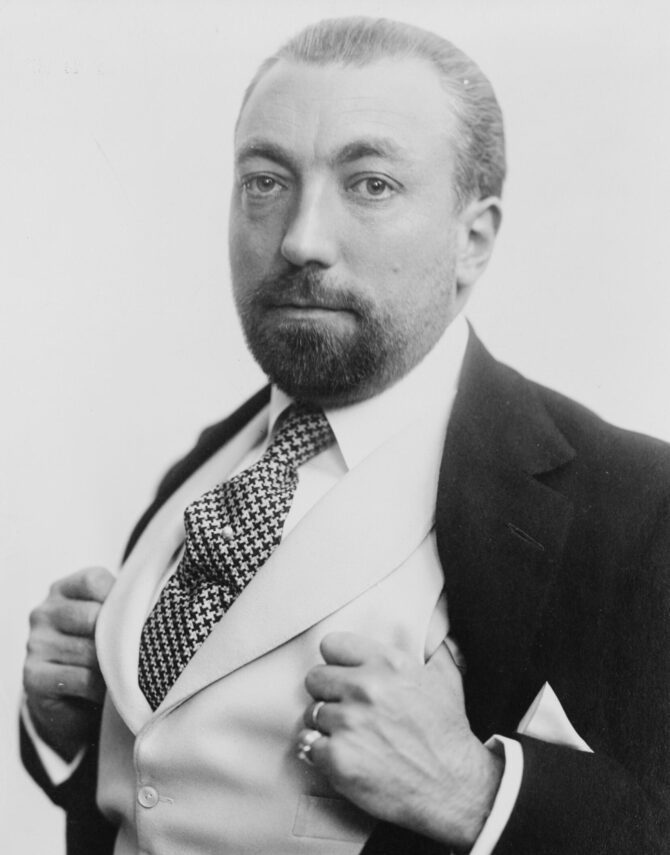

Following the sumptuous Charles Worth exhibition, which ended in September at the Petit Palais, comes another major retrospective at the Musée des Arts Décoratifs. Paul Poiret may not be as well known, but his signature silhouette is immediately recognizable in portraits and photographs of the pre-World War I era: long, tubular dresses, often with narrow hems or designed with a long tunic over the skirt in the style of the Ancient Greeks.
But Poiret didn’t limit his energies to just fashion: he was the first couturier to launch his own perfume line and branch out into home design and decor, each of these enterprises named after one of his daughters. In America his nickname was “King of Fashion,” and his lifestyle was as lavish as his clothes. In the end, this lavishness brought about the fall of the House of Poiret. Now, the Musée des Arts Décoratifs has brought together some 550 pieces to illustrate the breadth of his work, including, of course, dozens of gorgeous dresses from the early 20th century.
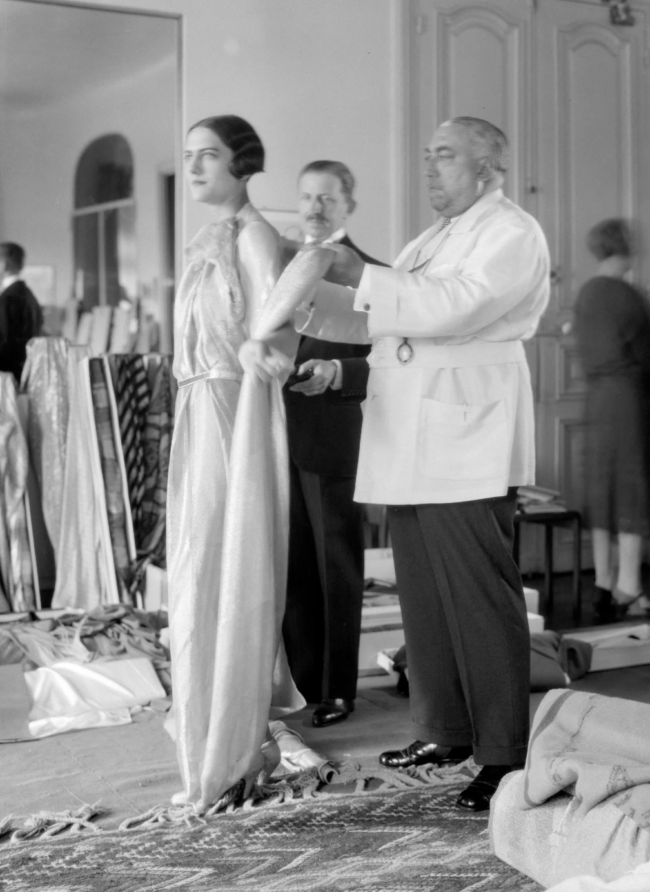
Thérèse Bonney (1894-1978). Paul Poiret and model Renée in the salons of his couture house, 1 rond-point des Champs-Elysées. 1927. Gelatino silver bromide print by ARCP, [198.], from the negative. © The Regents of the University of California, The Bancroft Library, University of California, Berkeley. Creative Commons Attribution 4.0 license.
Son of a draper, Paul was born in 1879, the only boy in a family of four children. He began his fashion career in 1898 as a sketch artist for the couturier Jacques Doucet. However, Paul’s highly original designs soon caught the eye of the greatest couture house in Paris, Worth, and in 1901 he was engaged to rejuvenate its designs and attract a younger clientele. It was not a happy relationship. Worth’s ultra-wealthy, older customers were wedded to their waist-cinching corsets and were not impressed with Poiret’s loose, shapeless clothes. He left in 1903 to open his own fashion house in the Opéra district.
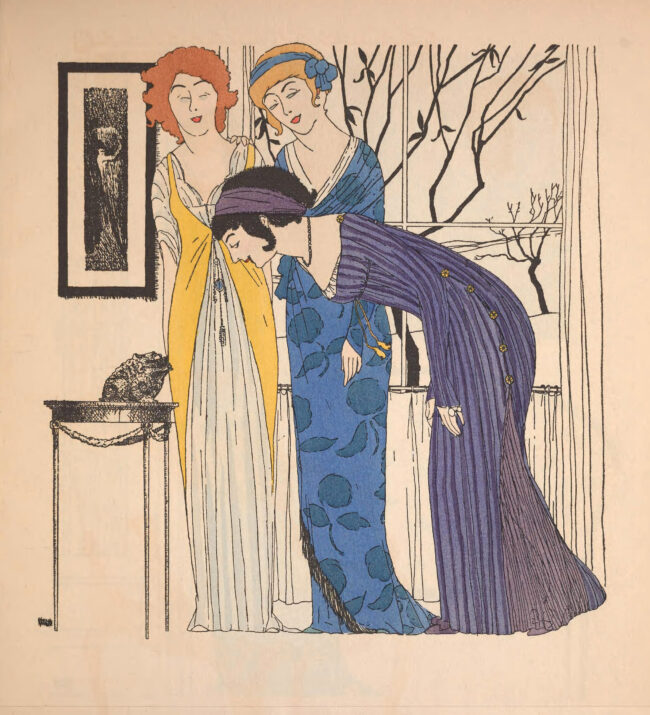
Poiret illustrations by Paul Iribe, 1908. Public domain
It was Poiret’s collection in 1906 that launched him properly as the most exciting couturier in Paris. The laced and boned corset was banished, replaced by loose, high-waisted dresses reminiscent of the Napoleonic era. Foundation garments were still worn, but the invention of the brassière and increasing use of elastic in corsetry spelt the end of the hourglass figure. It’s difficult, now, to imagine how liberating Poiret’s clothes must have seemed, especially as dresses were still almost ankle-length and for a while he favored hems so narrow they were known as “hobble skirts.” But he caught the zeitgeist if you like: women’s suffrage movements were taking off in Europe and America, and new employment opportunities such as telephonists, typists and secretaries were opening up for women. His loose clothes expressed young women’s desire for freedom.
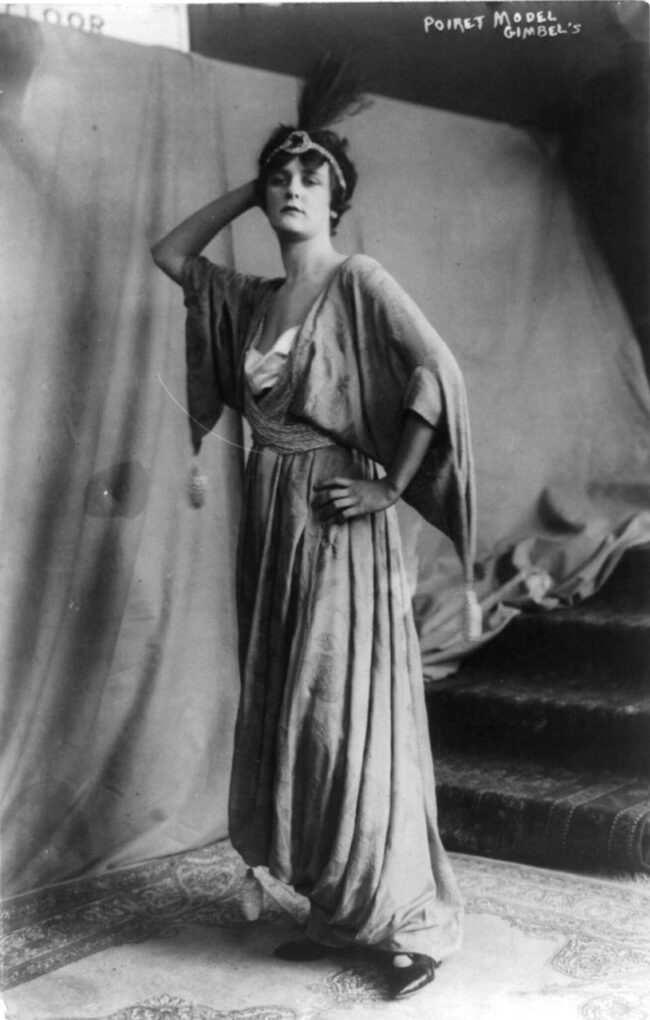
Model in a Poiret dress, 1914. Bain News Service. Public domain.
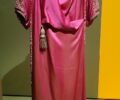
There is a dress in the exhibition, in red silk mousseline with a ruched neckline, which would not look out of place today, and this is perhaps the key to Poiret’s longevity. His clothes are still very wearable and look comfortable, more so than many creations of the later 20th century. Although the outfits in the exhibition represent the highest couture, Poiret’s silhouette was copied and adapted for mass-market womenswear, becoming the signature “look” of the first two decades of the century.
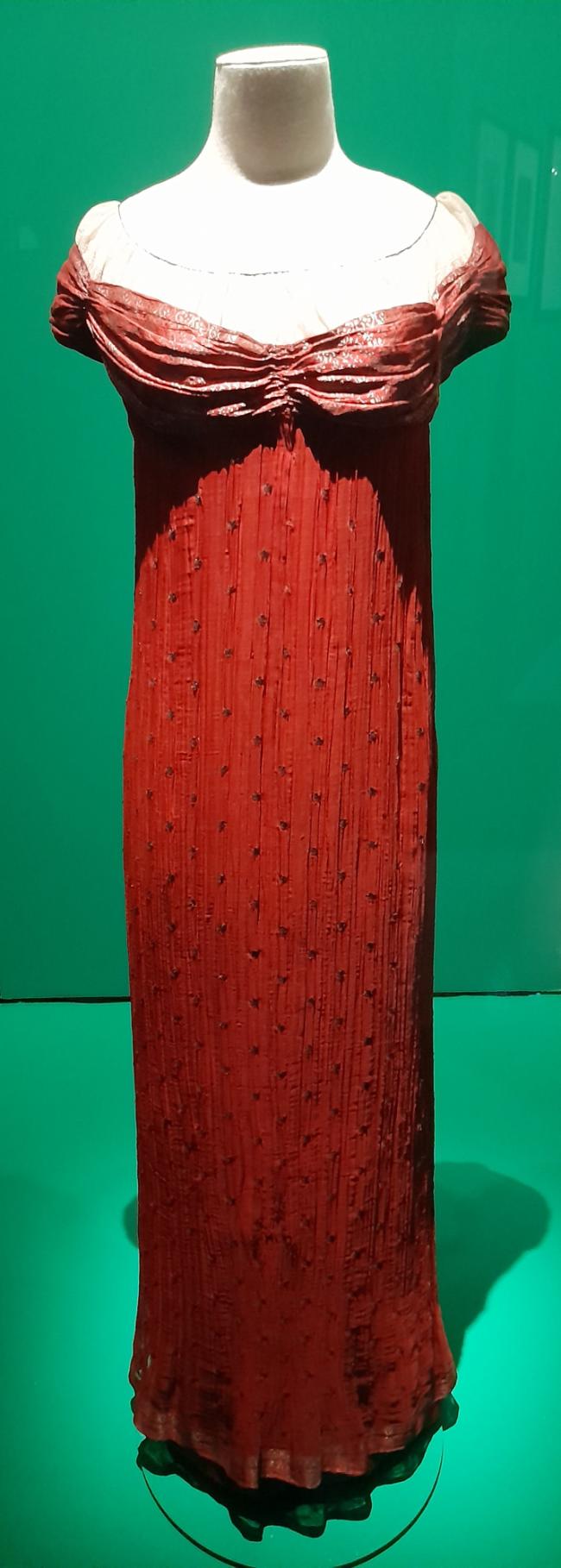
Evening dress c. 1908. Photo at the exhibit: Pat Hallam
But for the women who could afford him, Poiret dressed the leading society ladies, such as American heiress Peggy Guggenheim, in sumptuous style. His evening coats, in particular, are spectacular: heavily embroidered, beaded and generously trimmed with fur. His evening dresses shimmer in moiré silk, silk chiffon and taffeta with more beading and embroidery, often in silver and metallic thread. In 1905 he married Denise Boulet and she became his muse and primary model. Many of the outfits in the exhibition come from her private wardrobe.
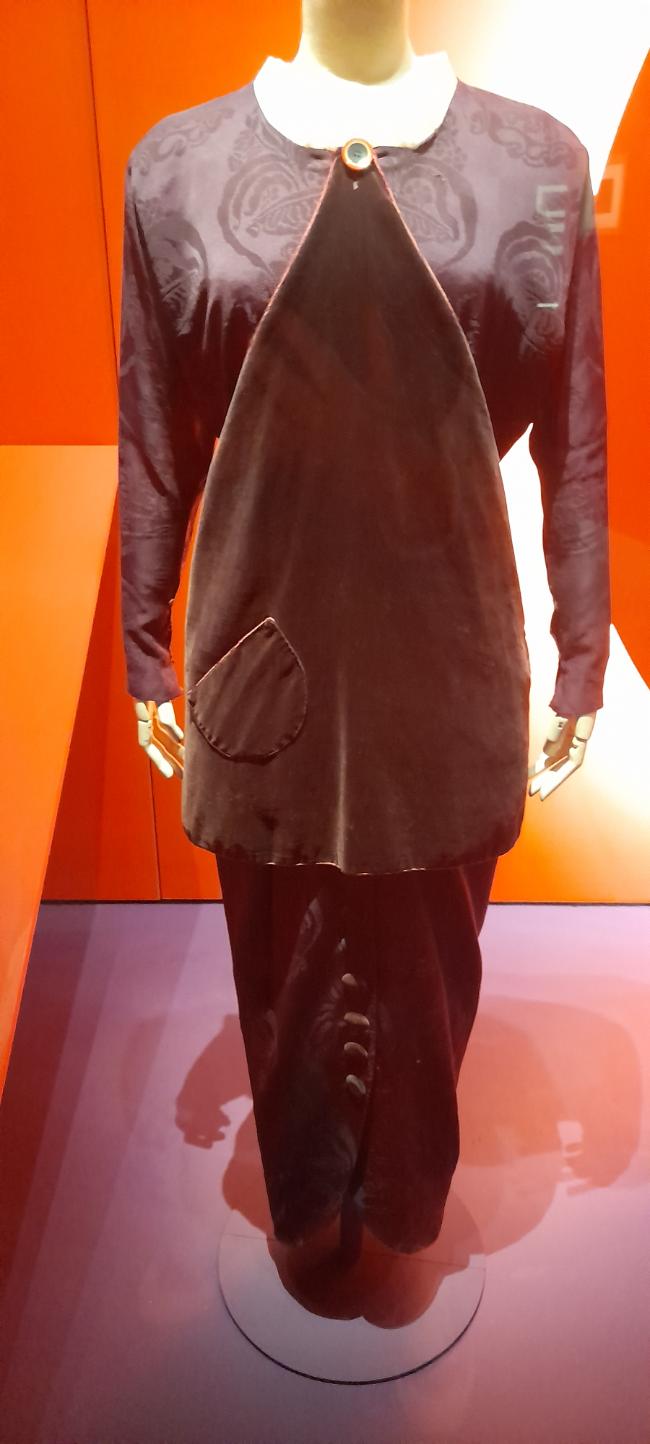
Dress belonging to Denise Boulet-Poiret, 1912. Photo at the exhibit: Pat Hallam
Poiret was a bit of a polymath and liked to collaborate with other artists: he had a long and enduring friendship with Raoul Dufy and was influenced by the Ballets Russes and Leon Bakst’s set and costume designs. He traveled widely: in 1910 a Mediterranean cruise to Italy, Spain and North Africa resulted in the turban becoming the most fashionable headwear, and the appearance of the notorious robe-culotte in 1911. This scandalous garment, based on harem pants, was effectively a split skirt forming a pair of ankle-length trousers, but often so disguised by voluminous pleats or folds that apart from a glimpse of the feet it was hard to tell it apart from a regular dress. Nevertheless, it caused a storm in fashion circles when it first appeared.
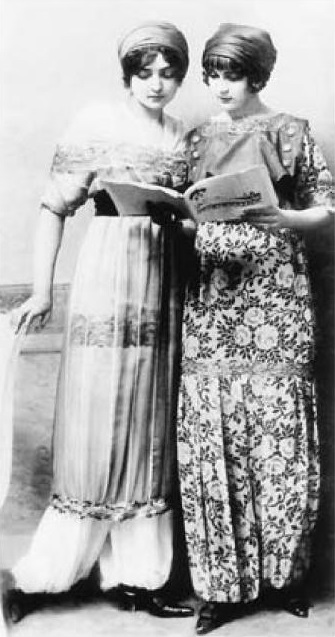
Poiret harem pants and sultana skirts, 1911. L’Illustration, 1911. Public domain
He was equally influenced by the simple, rectangular shapes of Japanese costume and there are dresses in the exhibition evoking the kimono and Japanese prints. Poiret’s rectilinear and geometric cuts also echoed the arrival of Cubism in painting around the same time.
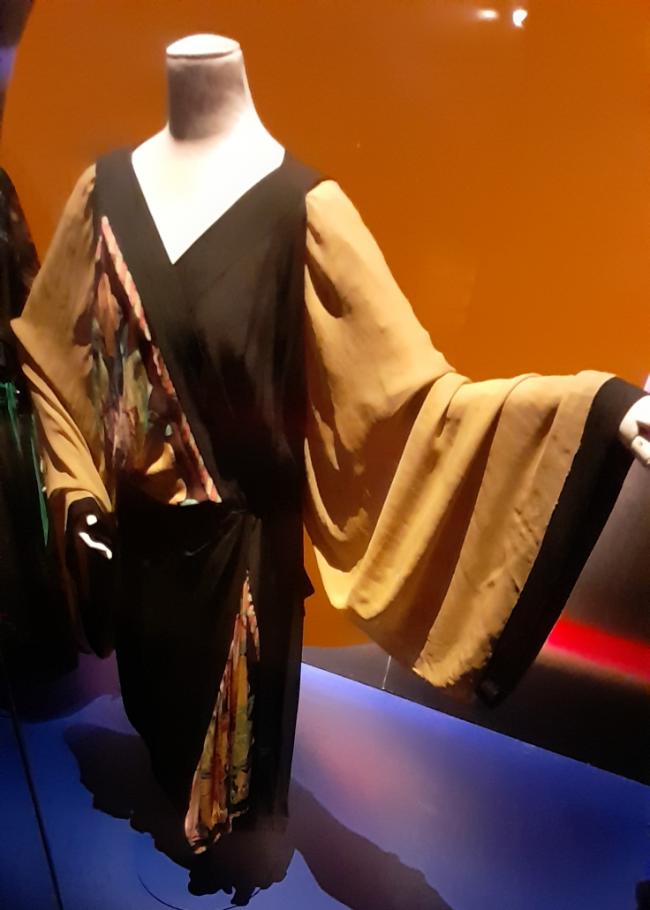
Japanese kimono-inspired evening coat 1922. Photo at the exhibit: Pat Hallam
Poiret’s lifestyle was as extravagant as his fashion. In 1909 he bought a property in the Rue du Faubourg St Honoré where he held his fashion shows but also lavish parties, especially fancy dress parties. One legendary soirée in 1911 was known as the Thousand and Second Night, inspired by the Ballets Russes’ recent production of Scheherazade and the Thousand and One Nights. Three hundred guests came, presided over by Poiret dressed as a sultan and his wife, Denise, as head of his “harem.” Later, in 1919, he built an open-air theater, L’Oasis, in the large garden for his parties.
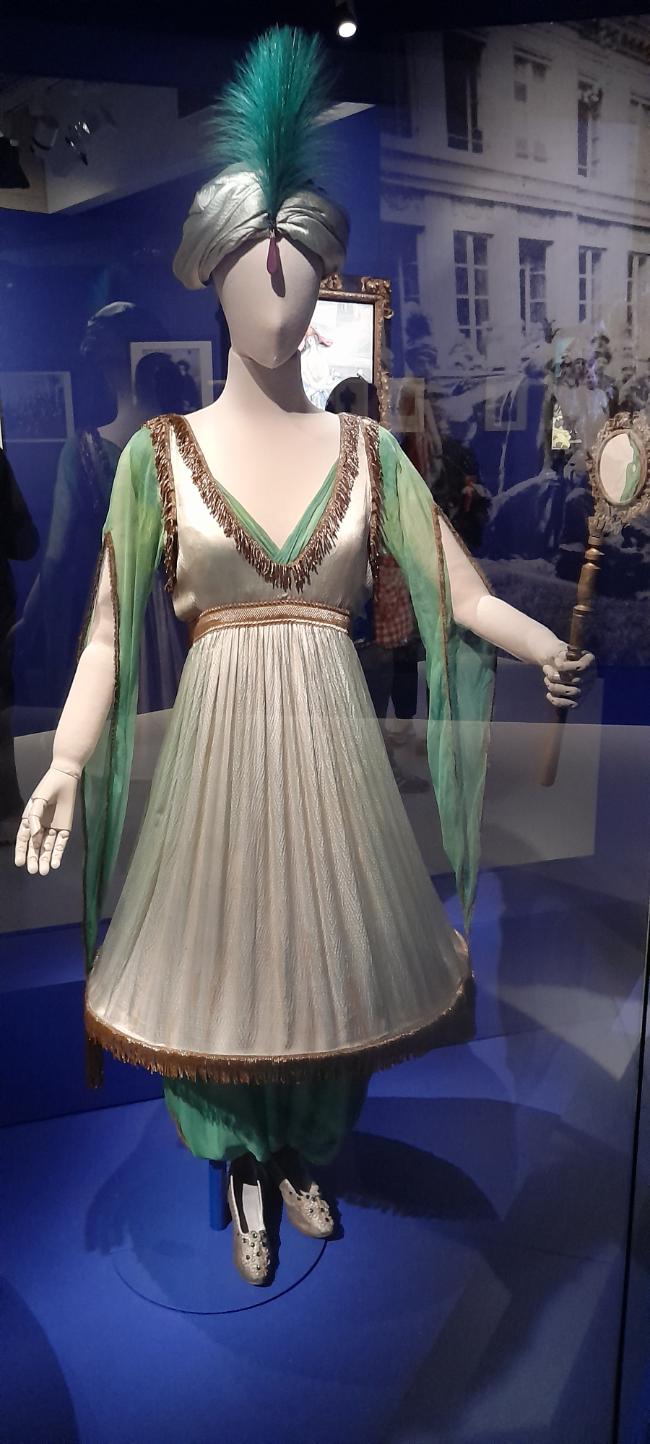
Denise Poiret’s costume for the Thousand and Second Night featuring the lampshade skirt. Photo at the exhibit: Pat Hallam
He was never just interested in fashion. His interests extended to interior decoration, furniture and art and in many ways he prefigured the diffusion lines that many of today’s designers produce. In 1911 he opened a school for young girls to learn drawing; he named it after one of his daughters, Martine. In later years the school played a pivotal role in designing the wallpapers, carpets, soft furnishings and, indeed, furniture that bore the Poiret name, as well as accessories.
In the same year he launched his first perfume, named La Rose de Rosine after another daughter. He was the first couturier to launch a range of perfumes and powders and paved the way for the classic fragrances of the 1920s and beyond: Joy by Patou, Arpège by Lanvin and, of course, No.5 by Chanel. Poiret’s glass bottles, several of which are on display, are works of art in themselves and he supervised all stages of their design, including the shape, the stopper and using students at Martine’s school to create beautiful painted decoration.
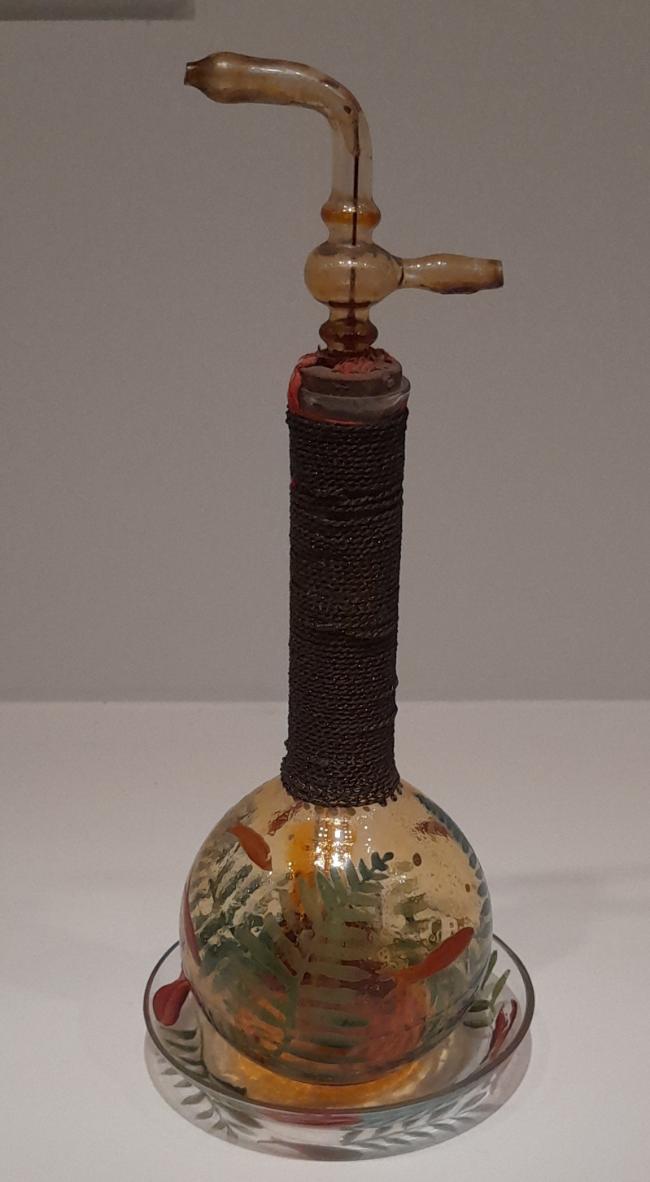
Perfume flacon by Poiret. Photo at the exhibit: Pat Hallam
The end of the First World War saw a subtle shift in Poiret’s designs. Dresses became slightly more fitted with natural waists and hemlines slowly started to rise. But he never again captured the zeitgeist the way he had in the prewar years. Despite only being in his 40s, he was unable to keep up with the next generation of couturiers, namely, of course, Coco Chanel. Ironically, Chanel did for liberating women’s fashion what Poiret had done in the 1900s. Her casual striped jerseys, loose trousers and knee-length skirts were as revolutionary as Poiret’s abandonment of the corset had been.
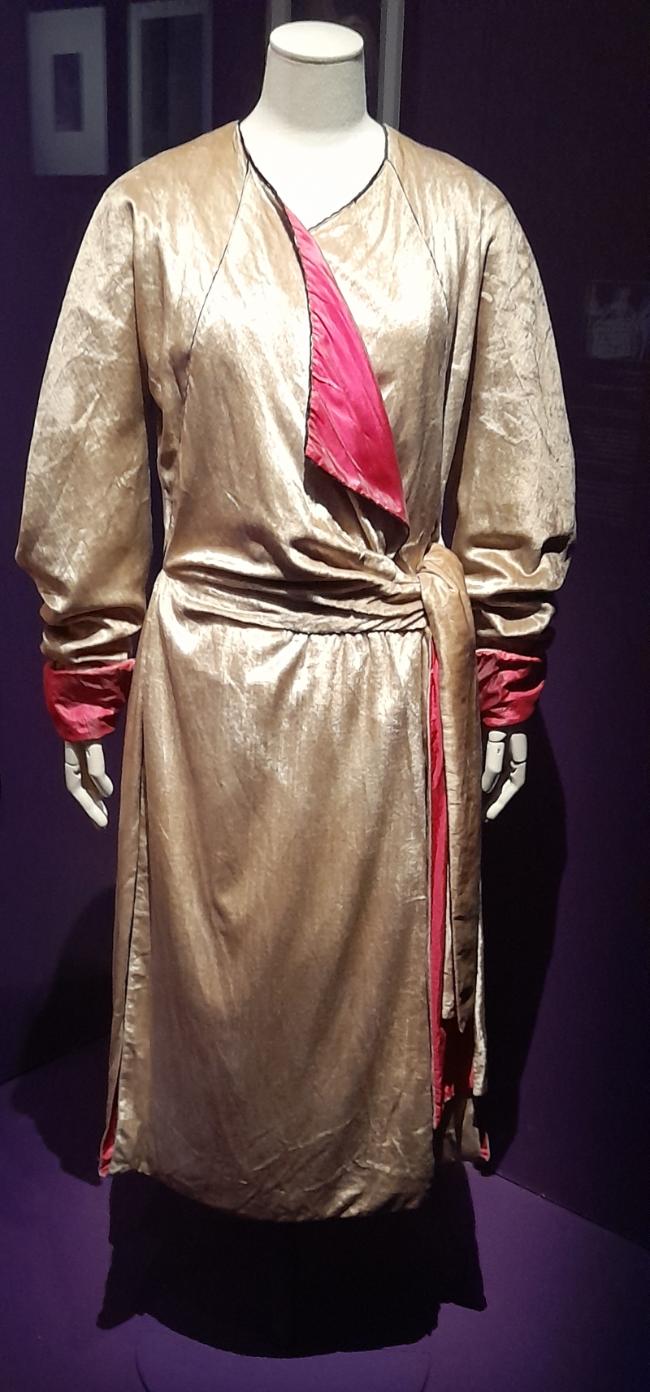
Evening coat 1920. Photo at the exhibit: Pat Hallam
Unfortunately, as Poiret’s fashion fortunes started to decline, this was not matched by a reduction in his lifestyle. If anything, it was just the opposite. Between 1920-23 construction started on the Villa Poiret in the Île de France, designed by the Modernist architect Robert Mallet-Stevens, but Poiret could not afford to have it completed. Even so, he owned homes in Biarritz and near Saint-Tropez, both places starting to become fashionable with the wealthy.
But what really sank him financially was the International Exhibition of Modern Decorative and Industrial Arts in 1925 (remembered mainly for launching Art Deco). For this, he rented three péniches, or barges, and moored them on the Left Bank. He named them Amours, Délices and Orgues and they were lavishly fitted out to showcase the decor and furnishings of the Atelier Martine. Fashion shows were held on the Orgues. Unfortunately, it was a hugely expensive failure. The barges were too far away from the main exhibition hall in the Grand Palais and the expected customers and spectators failed to materialize. Financially, Poiret never recovered from the losses he made and it marked the beginning of the end of the House of Poiret, which finally closed down in 1929.
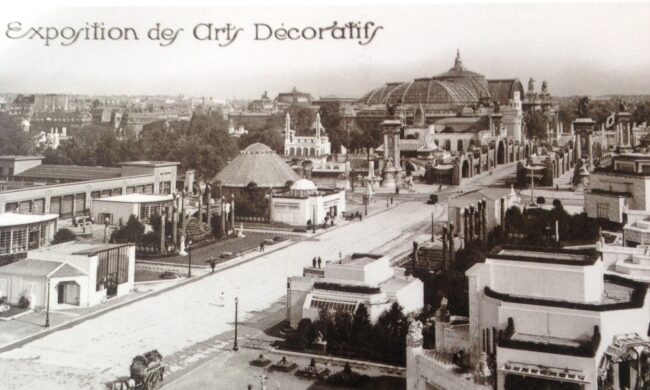
Postcard of the 1925 Exposition of Decorative and Industrial Arts in Paris. Wikimedia commons
Poiret never gave in to despair. In the 1930s he published three volumes of memoirs which became bestsellers in Britain, America and Spain as well as France. He invented the girdle, a more supple foundation garment based on woven elastic fabric and the ancestor of modern lycra shapewear, and devoted himself to his favorite pastime, painting. But financially he was ruined and bit by bit the luxurious homes and his great collection of art were sold off. He was abandoned by the wealthy customers whom he had dressed in the most sumptuous velvets and silks. But retaining a vestige of pride, and refusing to be humiliated by his status, he became one of Paris’s legendary clochards, the tramps who slept under the bridges of the River Seine. He died in 1944, penniless and forgotten.
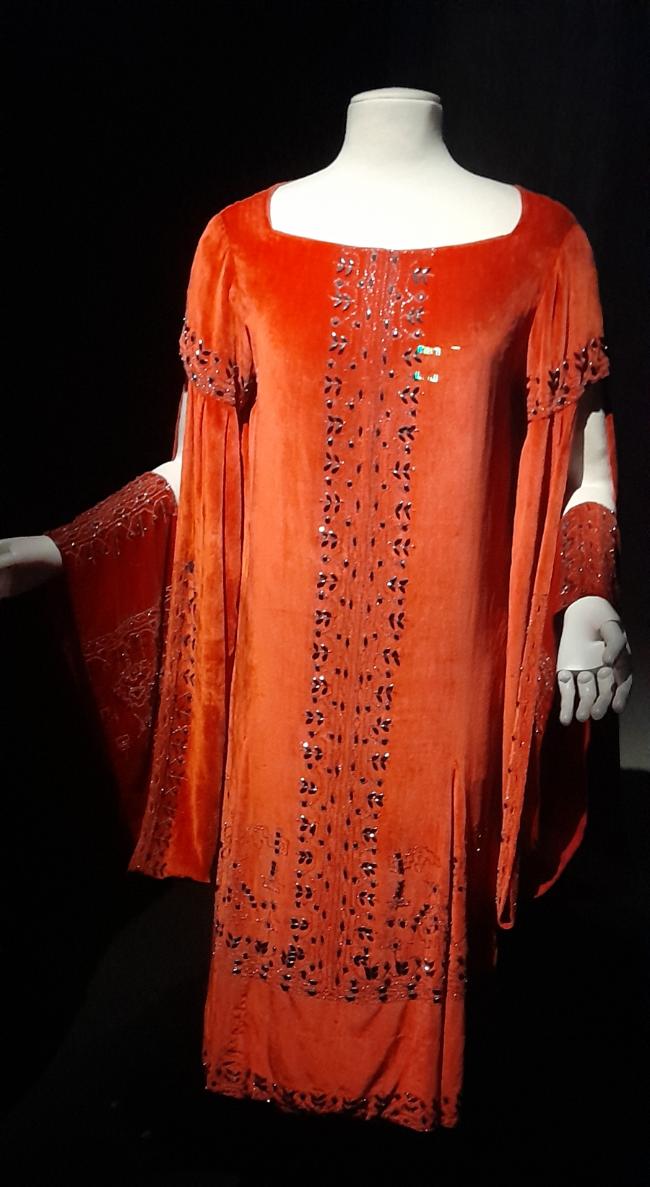
Such a sad end to a brilliant career. But his legacy has endured and contemporary designers including Christian Lacroix, Jean-Paul Gaultier and John Galliano have referenced him in their work. Now, 80 years after his death, his work and life are celebrated in this landmark exhibition. Alongside the clothes are sketches, magazine illustrations, perfumes, carpets, wallpapers, all of it bringing this long-forgotten era back to life. And at the heart of it, the dresses, the evening gowns and coats. Many of them are now so fragile that they may never be exhibited again, so don’t miss this opportunity to enjoy a glimpse into the luxury of the House of Poiret.
DETAILS
Paul Poiret: Fashion is a Feast
Until January 11, 2026 at Musée des Arts Décoratifs
107, rue de Rivoli, 1st arrondissement
Tel: +33 (0)1 44 55 57 50
Closed Mondays
Full-price ticket is 15€
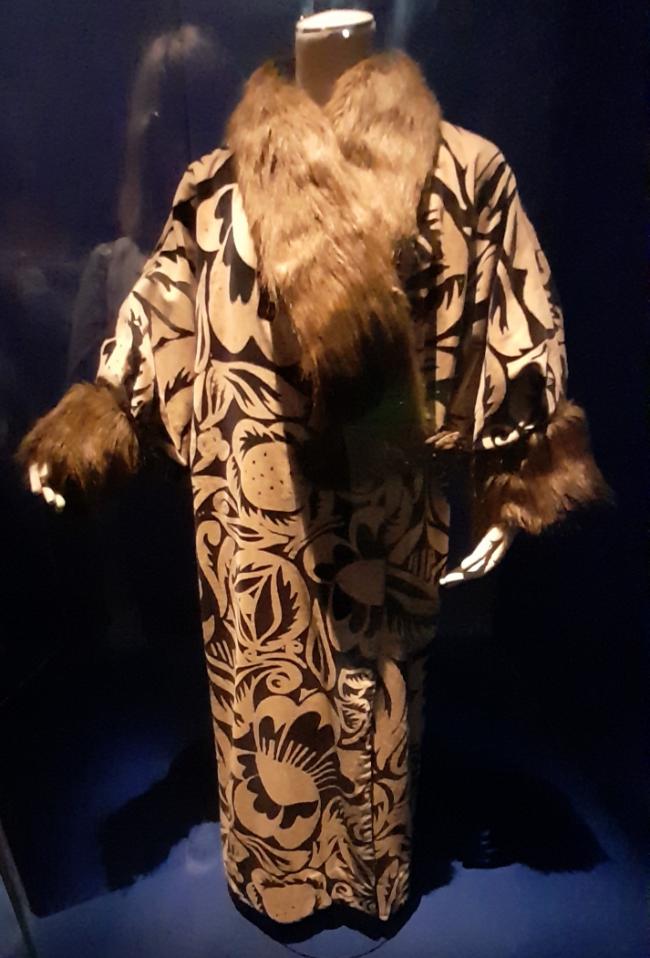
‘The Persian’ Evening coat by Raoul Dufy 1911. Photo at the exhibit: Pat Hallam
Lead photo credit : Portrait of Paul Poiret. Unknown author. Public domain
Share to: Facebook Twitter LinkedIn Email
More in MAD Paris, Musée des Arts Décoratifs, Paul Poiret
Related Posts

By Pat Hallam