Day Trips from Paris: A Fairytale Walk to Château of Ecouen

If you are looking for total dépaysement (change of scene) and are also interested in the French Renaissance, there is no need to travel as far as the Loire. One of the most elegant examples of this style in France, the 16th-century Château d’Ecouen, houses the rich furnishings and objets d’art that make up the collections of the National Museum of the Renaissance.
Perhaps because it is only 19 km and 21 minutes by train from Paris, the château, surrounded by its 17-hectare park which is full of flowers in spring and enchanting under snow in winter, is gratifyingly under-visited. Most of its visitors are French so you won’t have to join long queues.
The full impact of its hilltop site is only revealed when you approach it on foot via the signposted walk from the station through the Forest of Ecouen, a distance of 1.84 km, just over a mile.
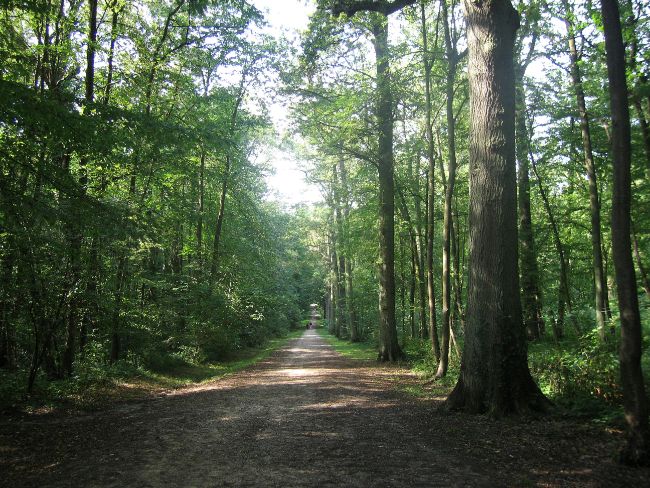
View of the forest walk from the Grille du Pré Curé. Photo: Annabel Simms
I first went there on the 269 bus from the station, only three stops to the château but by a route which means you approach the building from the front. When I went there again through the forest some years later, I actually failed to recognize it as the same place, so different were the two impressions.
The rear view of the château gradually rises into view as you approach it from the woodland path and is magically revealed in all its stateliness as you emerge onto the vast flat lawn at the top.

Rear view of the château in winter, surrounded by snowdrops. Photo: Annabel Simms

Rear view of the château in spring, with a carpet of wood anemones. Photo: Annabel Simms
The château was built for Constable Anne, Duke of Montmorency (1492-1567), the owner of over 130 châteaux and one of the wealthiest and most powerful men in France. Completed in 1555, it is in the High Renaissance style, a development of the Early Renaissance style of the châteaux of the Loire built during the reign of François I. The architecture, the grounds and the decor all reflect the new taste for a château as a place for gracious living rather than a medieval fortress. Painted friezes decorate the windows and walls and dreamy Biblical scenes are painted on the chimneypieces.

‘La chasse d’Esaü’, chimneypiece by unknown artist in the bedroom of Anne de Montmorency. ©RMN, Stéphane Maréchalle
From the terrace of the restaurant/tearoom and the upper floor windows there are superb views of the park, the roofs of the houses descending the steep hill to Ecouen and the rolling countryside of the Plaine de France beyond, recalling the hazy, stylized landscapes in medieval paintings.

View from a window on the upper floor of the château. Photo: Annabel Simms
The château was saved from destruction after the Revolution by Napoleon, who turned it into a school for the daughters of members of the Légion d’Honneur in 1806. The rooms now contain a fine selection of furniture, tapestries, glass and china made in France, Italy, Germany and the Netherlands in the 16th and early 17th centuries, representative of the Renaissance taste for elegance and refinement. The most famous exhibit is a priceless Brussels tapestry, woven c.1515, which extends over three rooms on the first floor and tells the story of David and Bathsheba, dressed, of course, in 16th-century clothes.
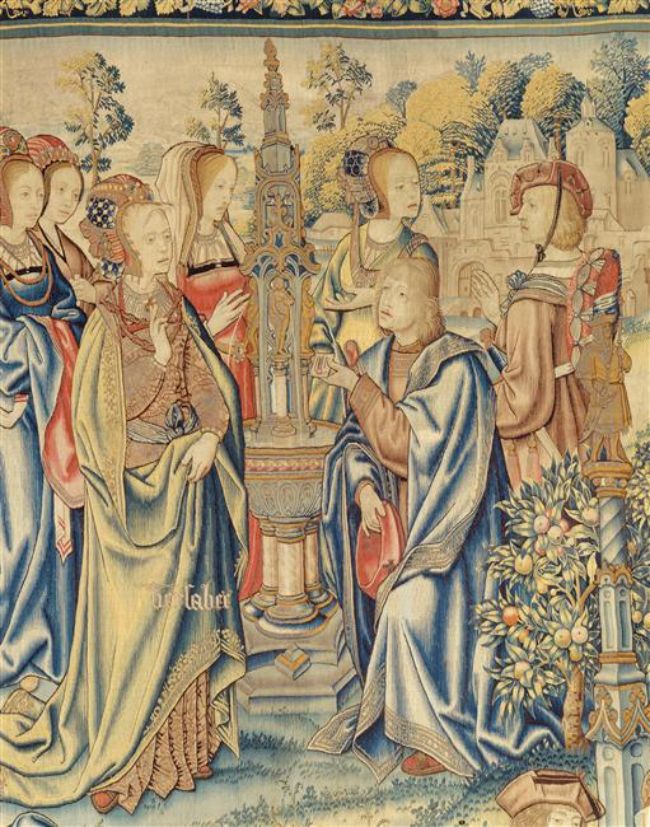
Bethsabée à la fontaine. ©R MN
Some other highlights are the Charles V clock in the form of a golden ship, complete with moving clockwork crew, shown in action in an accompanying video, on the ground floor

Charles V clock with automated crew, attributed to Hans Schlottheim (1547-1625). Photo: Annabel Simms
and the beautiful pink and blue Ottoman pottery from Iznik in Turkey, inspired by Chinese models, on the second floor.
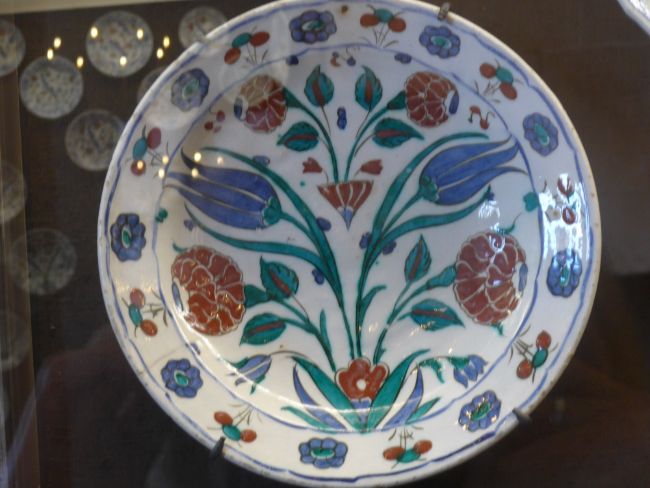
Plate from Izmir, 16th century. Photo: Annabel Simms
Getting to the château d’Ecouen by train and on foot
Trains to Luzarches or Persan-Beaumont stopping at the station of Ecouen-Ezanville leave the Gare du Nord every 15 minutes on weekdays and every half-hour at weekends, taking 19 minutes. There are two cafés at the station, one open on Sundays.
Cross the Place de la Gare diagonally to the right of the station exit, turn right at the boulangerie into the Allée du Bois and follow it into the forest. Turn right into the Chemin du Four à Chaux (paved) which rises gently uphill, then curves left and comes out at the junction of several paths. Turn right, following the sign to the château past the picnic area on your left. This unpaved road rises gently uphill to a gate set in the château wall, la grille du Pré Curé. Go through the gate, continue uphill past the signboard showing a map of the grounds and you will come out at the back of the château, with a superb plunging view of the Plaine de France on your left. Walk round the château to the right to find the main entrance on the other side.
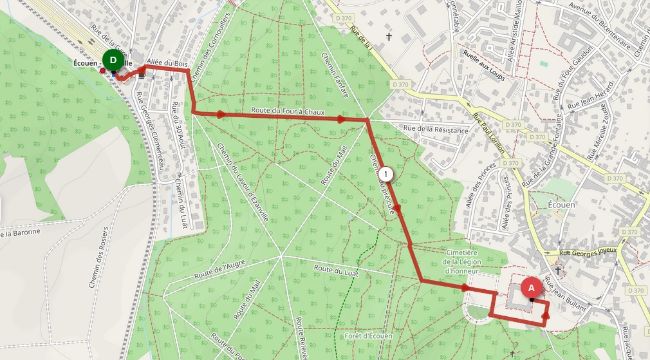
1.84 km walk from Ecouen-Ezanville station to the Chateau d’Ecouen
(NB Map and all photos are by Annabel Simms unless otherwise stated)
The new enlarged edition of Annabel’s book ‘Half An Hour From Paris’ will be on sale shortly. Details will be posted on her website www.anhourfromparis.com
Lead photo credit : Château d’Ecouen, main entrance. Photo: Annabel Simms
Share to: Facebook Twitter LinkedIn Email
More in chateau, ecouen, forest walks near Paris, Paris day trips
Related Posts