Film Review: Mon Crime, Directed by François Ozon
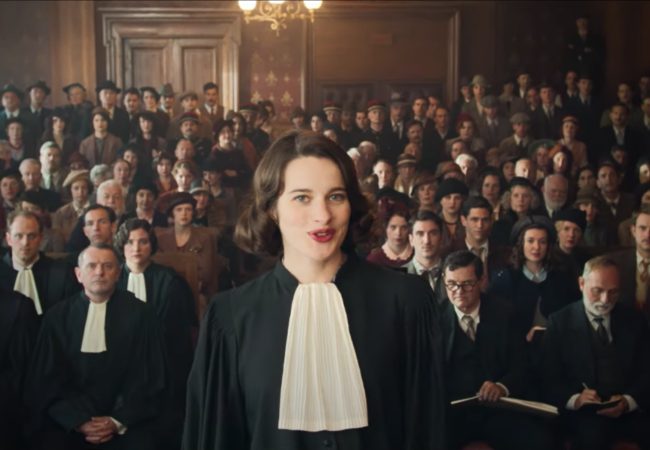
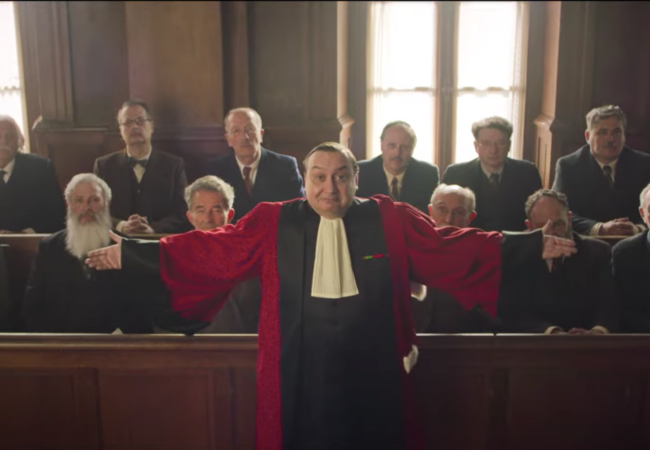
François Ozon’s delectable bonbon of a film shows its ironic hand right from the title. Mon Crime (literally “my crime”) evokes how the characters take a proprietary attitude to a felony, in this case murder, as if it were a jewel. In this quasi-farce (based on a play by Georges Berr and Louis Verneuil), a struggling young actress confesses to a crime she didn’t commit (killing an impresario who’d tried to have his way with her) with an eye towards boosting her career, and later an over-the-hill silent-movie star (who apparently did do the crime) wants to take belated credit, in order to stage a comeback. Then there’s the investigating magistrate who wants to keep the original verdict, which was a sensational demonstration of his crime-busting abilities (even if the young actress was ultimately acquitted).
Mon Crime. © Gaumont
There are complications, and an uplifting but ironic end. This sort of farcical mock-melodrama is characteristic of the popular fare in Paris’ “boulevard” theaters, where an often older public goes in for an evening of light (sometimes silly) entertainment featuring long-in-the-tooth performers. (Boulevard refers to the “grands boulevards” where the theaters are located, and came to denominate the broad comedies usually featured there)
Mon Crime. © Gaumont
The cast of Mon Crime is a mix of old and young. Madeleine Verdier (Nadia Tereszkiewicz), the actress, shares a dumpy apartment with Pauline Mauléon (Rebecca Marder), a fledgling lawyer. Ms. Tereszkiewicz and Ms Marder are not only playing their characters, but in a sense also playing the ingénues who played such characters in the boulevard theaters. They’re both attractive and charming, but somewhat similar in their physical appearance. When they’re not doing their respective schticks (actress-turned-defendant, defense counsel) they can be hard to tell apart.
Mon Crime. © Gaumont
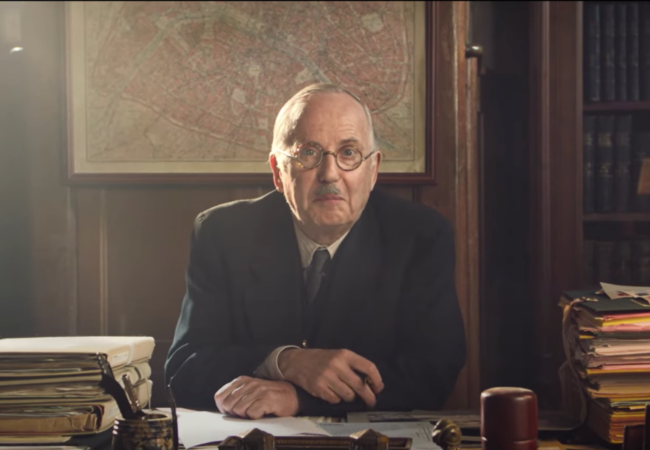
Our two heroines are surrounded by more familiar names. The always wonderful Fabrice Luchini plays Gustave Rabusset, the investigating magistrate. Isabelle Huppert exuberantly plays the washed-up star, Odette Chaumette. Best of all, Dany Boon gives a brilliant performance as Palmarède, a businessman from Marseille, with a perfect mastery of the Midi accent. Boon is one of a number of French-Jewish comics who’ve made of film and TV a virtual Borscht Belt, bringing a humane earthiness sometimes lacking in French comedy. He’s not the clown in Mon Crime, but he is the movie’s heart. Ozon excels at ensemble pictures, as he showed in his hit 8 Femmes; so he not only brings out the particular talents of his actors, but also the chemistry produced by their interactions.
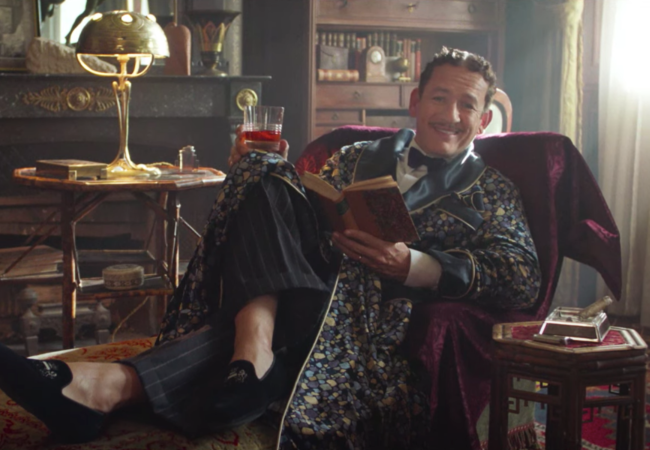
Mon Crime. © Gaumont
In terms of the narrative there’s a niggling problem at the beginning, when Madeleine decides to confess to “her” crime. We see the objective conditions that lead to her actions, so it’s plausible (at least in the context of comedy). But we don’t see her thinking about it, mulling it over, agonizing about her situation, or whatever — her decision feels too rushed, to the degree that it’s almost confusing. But the director will more than compensate for this shaky start with a nifty end that seems surprising but inevitable — and most of all, funny.
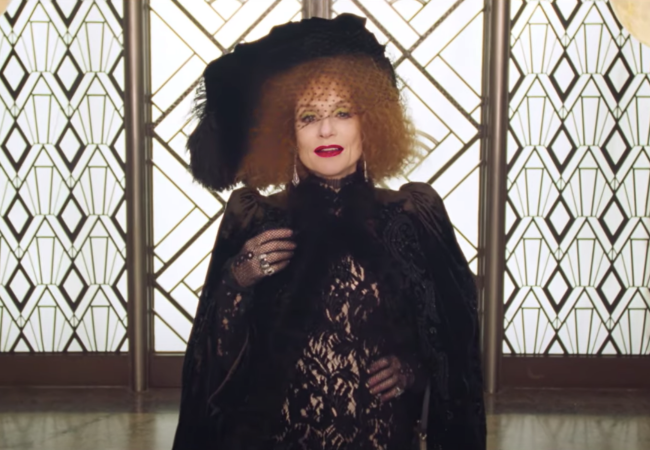
Mon Crime. © Gaumont
Ozon also has ideological fish to fry, in both a historical and contemporary way. He tries to make the story a MeToo parable. The murdered man was a Harvey Weinstein-type cad, and when Madeleine takes the stand in her defense she makes a sweeping indictment of the plight of women, not only relating to sexual predation but also the right to vote. Ozon’s heart may be in the right place, but the situation of women is already implicit in the film’s plot. We don’t need the harangues, which turn a few scenes into strident propaganda.

Mon Crime. © Gaumont
Interestingly, during this period (the 1930s), the Popular Front-led National Assembly voted several times to give women the vote, only to be stymied by the more conservative, and less representative, Senate. Ozon makes other historical allusions, as when a character is shown reading Je Suis Partout, an infamous anti-Semitic (and later, collaborationist) newspaper. But this is an isolated clin d’oeil — we don’t see or hear much about the political turmoil which wracked France at that time. The play Mon Crime is based on came out in 1934, the period in question, but as light entertainment, not a political play (it was first performed at the Théâtre de Variétés, a theater with a storied past that still exists on the Boulevard Montmartre).

Mon Crime. © Gaumont
Mostly, Ozon gives the viewer a taste of the special ambience, fizzy but brittle, and a bit claustrophobic, of boulevard comedy. The director also tries to “open out” the play into a more immersive cinematic experience, using timeworn methods, such as carefully detailed period sets and outdoor sequences. There are also variations in the visuals, shifting from static, indoorsy lighting and compositions to a brighter, airier touch. This isn’t completely successful, as is usually the case — most directors who’ve adapted Shakespeare have been there, not to mention major directors like Peter Brook. Theater, which can seem so fluid and true to life, has its own intractable forms, so the best one can hope for when using dramatic material is that it seem more like “adaptation-of-a-play” rather than “filmed play”. In those relative formal terms, Ozon brings it off, with lots of verve and a mastery of his craft.
Production: Mandarin Cinéma/FOZ/Scope Pictures
Distribution: Gaumont
Lead photo credit : © Gaumont
Share to: Facebook Twitter LinkedIn Email
More in comedy, Dany Boon, Dimitri Keramitas, Drama, Fabrice Luchini, film, film review, FOZ, François Ozon, Gaumont, isabelle huppert, Mandarin Cinéma, Mon Crime, Nadia Tereszkiewicz, Rebecca Marder, Scope Pictures
Related Posts