
Moments in Paris: The Robert Doisneau Exhibition

Currently on display at the Musée Maillol in the 7th arrondissement is a carefully curated collection of some 400 pictures taken by Robert Doisneau, arguably the best-known French photographer of the last century. The connection between two such different artists – the sculptor whose work referenced classical Greek and Roman traditions and the photographer whose 450,000 images captured so many facets of mid-20th century Paris – lies in a story which tells us much about how Doisneau approached his work.
One day in June 1964, he was passing along the Rue de Rivoli on his way to an agency meeting when he saw a sight so arresting that he abandoned all his plans for the day and began taking impromptu photographs. Workmen were busy unloading a number of large bronze statues by Aristide Maillol in preparation for an installation in the Tuileries Gardens. For Doisneau, the singularity of the moment and the juxtaposition of the everyday workmen and the classically elegant statues was unmissable. As on so many other occasions, he took his Leica camera out of its case and began capturing the scene unfolding before him in a whole series of pictures.
The current exhibition of Doisneau’s work is a retrospective covering many different aspects of his career, but space is set aside to pay tribute to this story. Some of Maillol’s statues are displayed near the photographs he took on that summer day when they so captured his imagination. A further connection between the photographer and the world of fine arts is explored through the pictures he took of members of the public looking at works of art. In one, an elderly man in a respectable trilby hat smiles as he contemplates a painting of a saucy nude displayed in a shop window. In another, visitors to the Louvre lean over curiously for a closer look at the Mona Lisa. For Doisneau, the painting, which does not feature in his photograph, was far less interesting than the expressions of the people who have come to see it.
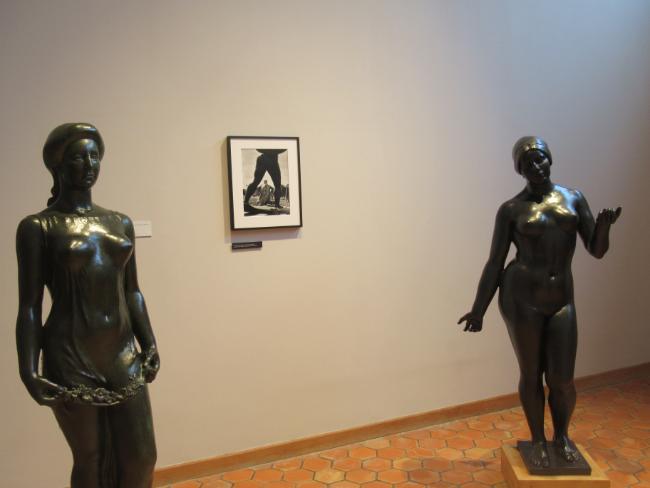
“Robert Doisneau, Instants Donnés” exhibition at the Maillol museum. Photo: Marian Jones
Doisneau’s fascination with people, many of them not conventional subjects for photography, first showed itself in the 1930s when he was employed as an industrial photographer for Renault. It was there, he explained, that he learned an early respect for working people and felt compelled to capture what he called “the treasure” within them, the dignity of their work despite the hard lives they led. There is a realism about the photographs of factory workers, miners and laundry women displayed here. Sometimes it’s a hard-hitting treatment, such as his depiction of steelworkers’ hands, most missing at least one finger and sometimes a quirkier take, for example a group of hairdressers soaking up a little sun at a pavement table outside their salon.
Doisneau had an affinity with children, especially those growing up in la banlieue as he himself did. He spoke affectionately of capturing their playfulness, their “irrepressible need for freedom” and their “joyful insolence” in pictures showing two boys climbing a lamppost, a crowd of youngsters hurtling exuberantly down the Champs de Mars towards his camera and little girls on a row of chairs outside the Palais Royal, seemingly caught on camera just before springing up and running off in all directions. But he captured more thoughtful moments too: children searching for pieces of precious coal on the banks of the Seine in 1945, a small boy crossing the road to school with his new briefcase, a classroom scene where one inattentive child is glancing up at the clock.
Doisneau photographed many well-known people too, including the writers and artists he got to know through his work, meeting up in cafes, visiting their studios and taking their portraits. He loved to wander the quartiers populaires (working class districts) of Paris with the poet Jacques Prévert, each inspiring the other in their work. Prévert advised him to point his camera at “whatever chance brings” and “make a bouquet of it,” neatly summarizing Doisneau’s knack for capturing unexpected moments as they arose and making something memorable from them.
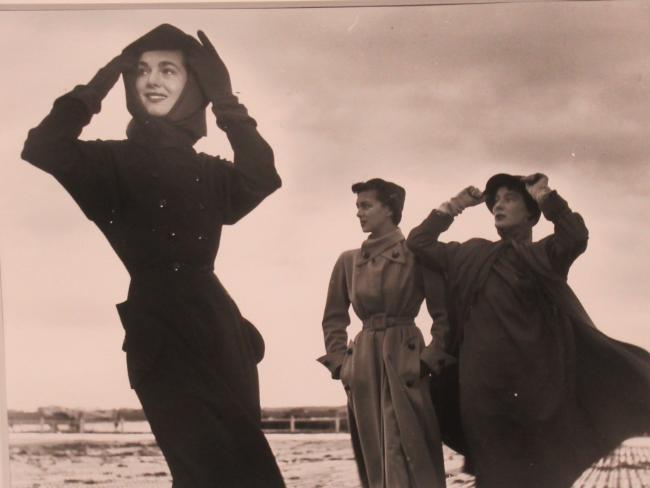
“Robert Doisneau, Instants Donnés” exhibition at the Maillol museum. Vogue fashion picture, c 1950. Photo: Marian Jones
Alongside portraits of Prévert, Picasso, David Hockney, Simone de Beauvoir and many other well-known faces, you will see examples of the glamorous subjects from the world of fashion and high society he photographed while working for Vogue in the early 1950s. He felt, he said, like the gardener’s son who had been invited to play with the children of a chateau, tasked with bringing a new perspective, but never really fitting in. He never stopped photographing ordinary people. As well as countesses at a ball and glamorous models in front of luxury cars, there are such subjects as two butchers outside their shop in Rue Montorgeuil in 1953 and “Monsieur and Madame Cosseroy in their home,” taken in 1986.
Above all, Doisneau took pictures of Paris in all her guises, capturing the factories and the back streets as well as the Eiffel Tower and the Tuileries Gardens. He especially loved the bistrots, saying to have favorite was good, to have several was even better and he took many photographs inside them, depicting moments of conviviality or reflection, perhaps miners having a quick drink at the end of a long shift or customers pausing to listen as an accordionist begins an impromptu performance. It is hard to pick out one special subject when his range was so all-encompassing, but his interest in la banlieue, the Paris suburbs where he had grown up, never wavered.
His first book, published in 1949, was titled La Banlieue de Paris and was followed by over 20 more volumes where the subject matter remained broadly the same. He wanted, he said, to shed un regard impitoyable (a merciless gaze) on the difficult conditions in which the citizens of the banlieue lived, especially in the post-war years, but many of his pictures also record tiny moments of joy: children playing street football, a young couple pausing from a bike ride, people dancing in the street on the 14th July. He cast an equally all-seeing eye over the huge changes of the 1980s, taking stark pictures of the new blocks which sprang up in the suburbs, creating a bleak new environment lacking in humanity. “I know it was ugly before,” he said, “but today it’s equally ugly, just different.”
The title of the exhibition, Instants Donnés (Given Moments) sums up this very varied collection of Robert Doisneau’s work. It’s strange that the best-known of all his photographs, the Baiser de l’Hotel de Ville (The Kiss at the Town Hall) is not here, although its story is told. The seemingly spontaneous embrace, captured on the Rue de Rivoli in 1950, was in fact staged by two actors hired to walk from Place de la Concorde to the Hotel de Ville stopping to kiss “as often as possible” for Doisneau’s camera. The picture attracted little attention when first published and only in 1985, when it was made into a poster, did it suddenly become an iconic image, one which represented the carefree spontaneity – real or imagined – of Parisian life to a global audience.
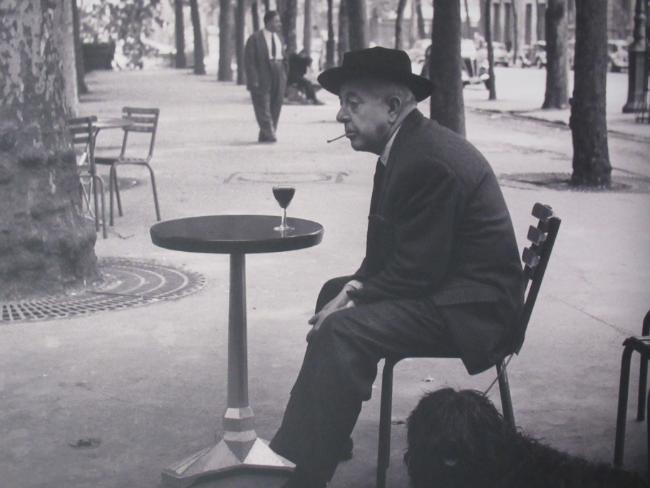
“Robert Doisneau, Instants Donnés” exhibition at the Maillol museum. Portrait of Jacques Prevert. Photo: Marian Jones
The exhibition does a marvelous job of conveying the sheer joy which Doisneau, the man who rarely went out without his camera, found in his work. He’s remembered by his daughter Francine, who co-curated the exhibition, as someone who “observed life with the patience of an angler,” watching, even when there seemed to be nothing much to see, then catching little unexpected moments on film. He adored his profession, claiming that no other would have allowed to enter both the lion’s cage at Vincennes Zoo and Picasso’s studio. A lifetime’s work making unforgettable images was summed up by the photographer himself quite simply as the art of capturing “the moments which delight me.” And if you can get to the exhibition, showing until October 12th, you will surely love them too.
DETAILS
Robert Doisneau Instants Donnés
Musée Maillol
59-61 Rue de Grenelle
Nearest metro stations: Rue du Bac, Saint-Sulpice, Sèvres Babylone
Until October 12th, 2025
Open every day from 10:30am to 6:30pm (Wednesdays until 10pm) € 16.50
Concessions €12.50
Children under 6 free
Lead photo credit : Robert Doisneau exhibit at the Maillol Museum
Share to: Facebook Twitter LinkedIn Email
More in Robert Doisneau
Related Posts

By Marian Jones