
Visit the 400-Year-Old Palais Royal
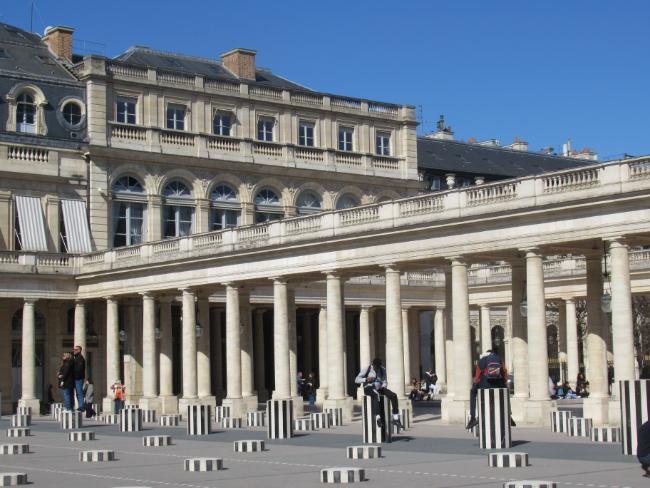

Parisians know that the classiest little haven of tranquility just a five-minute walk from the Louvre is the garden of the Palais Royal. There, relaxing on benches decorated with literary quotes, strolling the pathways lined with lime trees, pausing to admire the splash of a fountain or the pink froth of the magnolias, you can lose yourself in a book or just enjoy a few minutes of peace. And yet its past has often been decidedly more turbulent than tranquil. An exhibition earlier this year, marking 400 years of the Palais Royal, made it clear that over the centuries this site has been both a hub of raucous entertainment and a hotbed of radical ideas, the place where several revolutions can be said to have started.
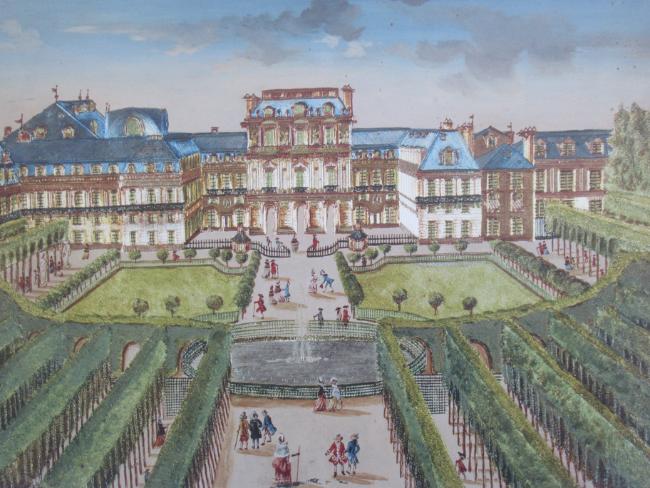
It began in the 17th century as the Palais Cardinal, the palatial residence Cardinal Richelieu built for himself and it only became royal when he left it in his will to Louis XIII. As he grew up, Louis XIV preferred other palaces – the Louvre, Saint-Germain-en-Laye, Versailles – and the Palais Royal became the Paris base of his younger brother, Philippe, Duke of Orléans (1640-1701). He and his wife created the ornamental gardens and began hosting lavish gatherings which gradually established their home as the place for the crème de la crème of French society to mix and mingle. The palace then passed down the Orléans line, becoming livelier and more decadent as time went on.
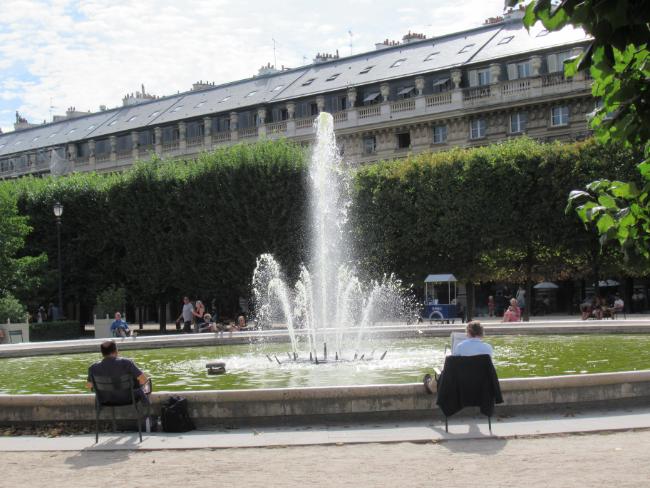
Palais Royal garden and bassin. Photo: Marian Jones
Louis Philippe d’Orléans (1747-93) needed money fast to fund his extravagant lifestyle, so he had apartments and arcades built around the edge of the grounds and rented them out, inviting the public in to shop, eat and seek entertainment. It proved extremely popular and before long the clientele widened to include all layers of Parisian society, from the elite to assorted gamblers, pickpockets and prostitutes. Debauchery aside, it is surprising to realize that many of the activities available at the Palais Royal today have their roots in this 18th-century flourishing.
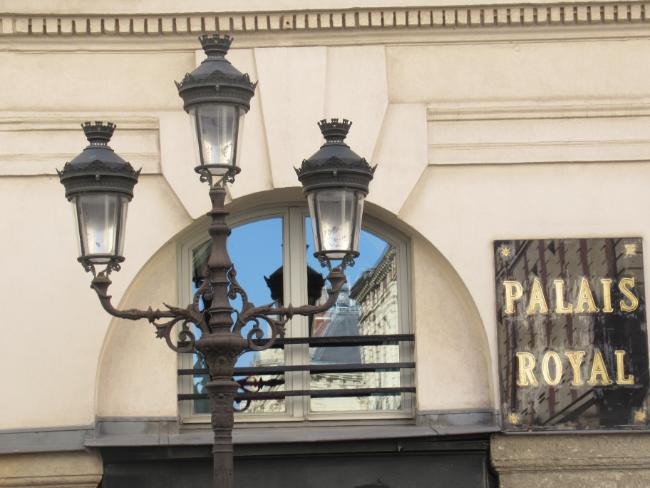
Arcades in the Palais Royal. Photo: Marian Jones
Today, for example, you can still tour the arcades down each side and find shops selling fashionable clothes, accessories and art, all of which 18th- and early 19th-century shoppers bought here too. The difference is that today the city’s most fashionable shops are elsewhere, whereas in its heyday the boutiques of the Palais Royal were the very last word in choice and elegance. An English visitor waxed eloquent in 1801 about the jewelers who “vied with each other in displaying in their windows all the taste, fashion, and magnificence of their choicest merchandise” and the milliners who “brought forth their finest lace, their most tawdry colors, and their most extravagant patterns.”
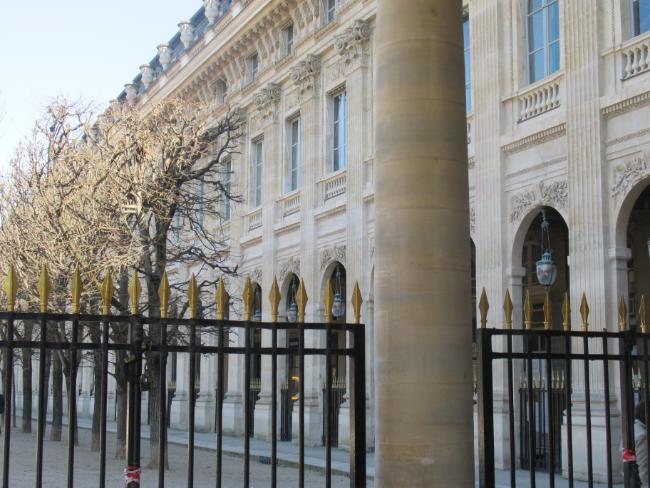
Palais Royal arcades. Photo: Marian Jones
Eating options today range from the good value La Crème du Palais Royal to the exclusive Palais Royal restaurant, with its two Michelin stars and status as one of Les Grandes Tables du Monde. You won’t find the same choice as the array of inns, taverns and restaurants which greeted customers in previous centuries, but you can still eat in a venue which first opened in 1784. Le Grand Véfour (originally Le Café de Chartres) soon became famed for its cooking, outlasted all the many other restaurants and has been a favorite haunt of politicians and the litterati for over two centuries. You can enjoy lunch or dinner in its splendid 18th-century décor any day from Tuesday to Saturday.
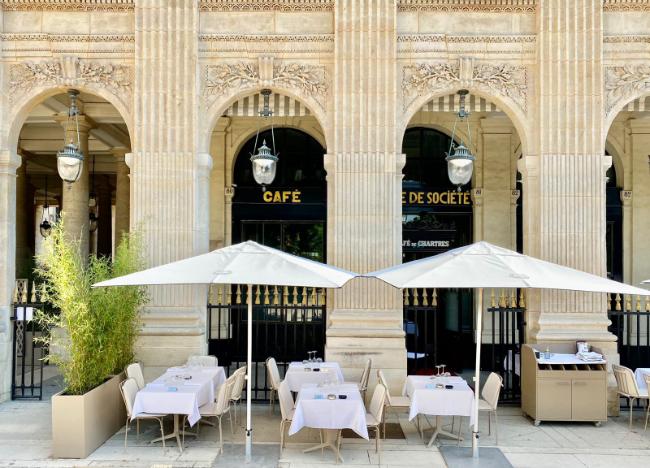
courtesy of Le Grand Vefour
There are still two working theaters linked to the Palais Royal, providing another link to the revelries enjoyed in past centuries. Inside the complex is the Théatre du Palais-Royal, on the site where Louis XIV installed Molière and his troupe of actors in the 1660s. Its current program includes Rostand, an energetic comedy based on Cyrano de Bergerac. Performances here are all in French, but at the nearby – and much more famous – Comédie Française you can borrow “smart glasses” which provide subtitles for the play in English (or other languages). A French classic on the current program is Moliere’s Misanthrope, supplemented by pieces in translation by such varied authors as Chekhov and Agatha Christie.
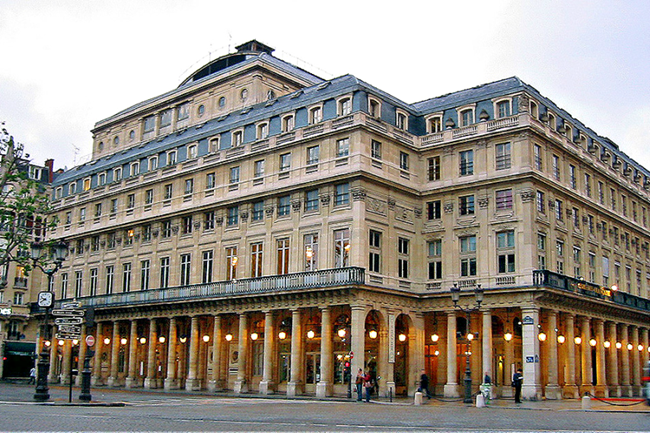
La facade de la Comedie-Francaise, seen from the Avenue de l’Opéra, 2007. Photo Credit: Dottore Gianni
Sadly, today you can no longer find the puppet theater enjoyed by audiences in the Palais Royal’s heyday. Nor will you come across the dwarfs and giants, colorful wax figures, wandering sellers of curiosities or fairground attractions through which those trying to make money sought to attract attention. The English journalist, John Scott, visiting in 1814, recorded the atmosphere as “dissolute, gay, wretched, elegant, paltry” all at once and described the endless “sights of fascination” he encountered, something quite hard to imagine when wandering among the peaceful flower beds today.
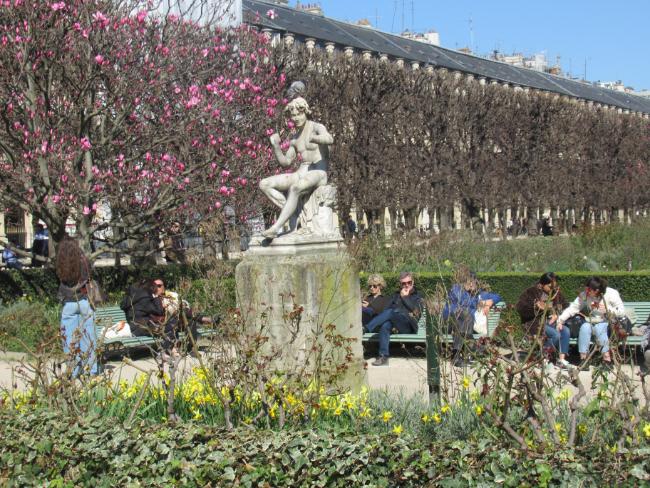
Palais Royal garden. Photo: Marian Jones
Scott was also struck by the numerous gambling houses and spotted a pawnbroker’s where, he surmised, “a ruined gamester” could get a little more money to try his luck once more by handing over “his watch, his buckles and sometimes his coat.” The free-and-easy atmosphere which attracted so many pleasure-seekers gradually gave way to more sordid activities. Prostitutes roamed freely and there were rooms on the upper floors for them to retreat to with their clients, one of whom, famously, was an 18 year-old Napoleon. Scott noted the desperation of some of those he saw, writing that if a man’s last-ditch attempt to recoup some of his losses failed, then “a pistol, or the river, ends his miserable days.”
Today, the Palais Royal is the seat of the Ministry of Culture and of the Conseil d’État which advises the government on legal matters and that’s fitting because the site has long been associated with politics. When the royals and their key advisers lived here it was a seat of power and when it opened up to the public it became a place to read newspapers in the coffee houses, to discuss politics and to listen to those who came here to make speeches. In July 1789, Camille Desmoulins addressed a crowd here, calling so convincingly for them to take up arms and storm the Bastille prison that it is not an exaggeration to say the French revolution was unleashed here.
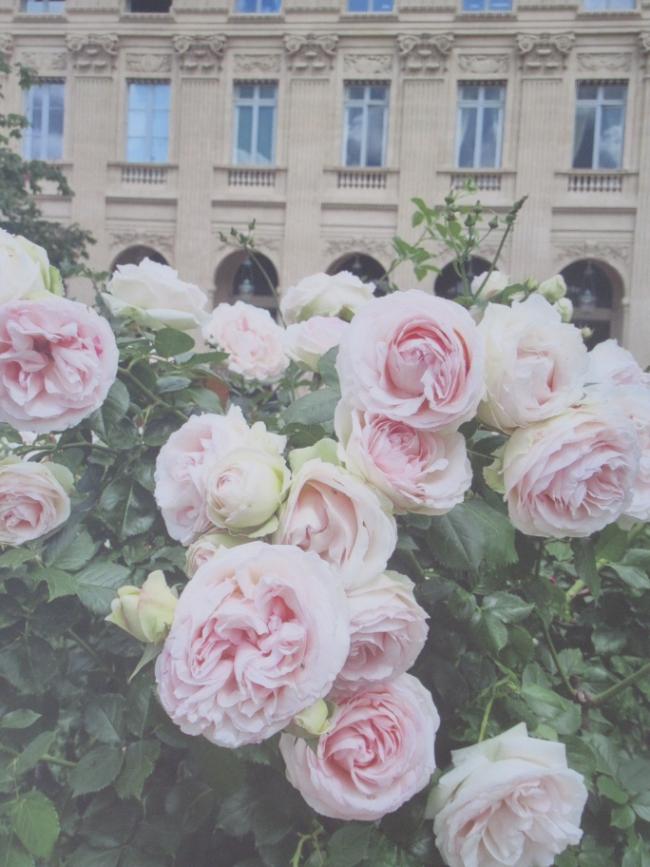
Exhibition at the Palais Royal, the garden’s roses. Photo: Marian Jones
Philippe d’Orléans, in residence as the revolution broke out, promptly renamed it the Palais Égalité, or “Equality Palace” and the grounds became the Jardin de la Révolution. He even voted for the death of his cousin Louis XVI, but this attempt at moving with the times failed and he too was guillotined a few months after the king. The riots of 1830 and 1848, both of which led to revolutions which toppled later monarchs, began here. After another republic and another empire, the people, as so often in France, had the last word, when communards set the palace on fire in 1871. It was saved from total destruction, but handed definitively to the state to use for administrative purposes.
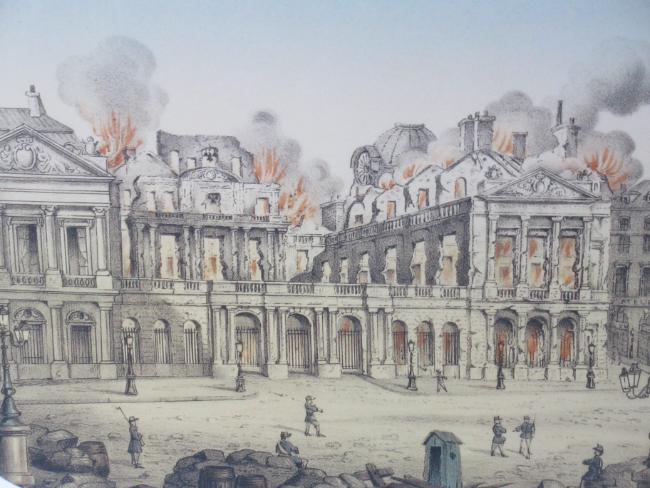
Exhibition of the Palais Royal, after the fire of 1871. Photo: Marian Jones
Visiting the Palais Royal today
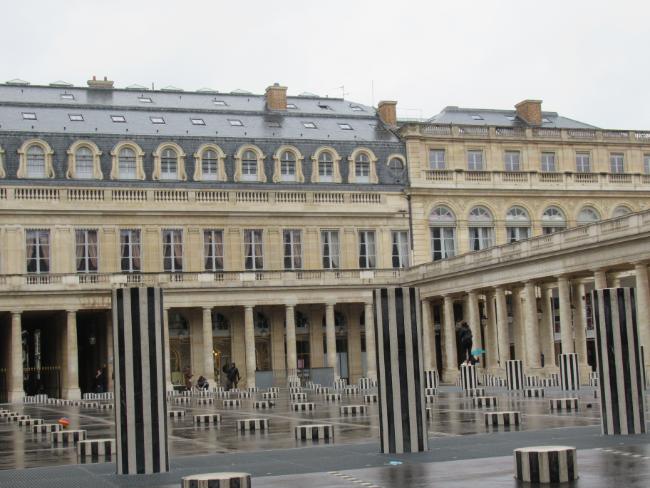
Parisians stroll through the grounds and relax on the benches when they need a moment of respite. As well as copying them, you may like to explore the Cour d’Honneur, the main courtyard, where two modern sculptures – Daniel Buren’s black and white columns and Pol Bury’s fountains – contrast with the surrounding classical architecture. Or wander the arcades and look out, amid the boutiques, for a new gallery, opened in June 2025, the Acne Paper Palais Royal, which will offer exhibitions, artists’ talks, book signings and other cultural events. The connection between art and the Palais goes right back to the 17th century, when Cardinal Richelieu had two galleries built to house his favorite paintings.
Explore the gardens and you’ll find many connections with the past. The original design was by Jean le Nôtre, father of the more famous André and comprised forerunners of the long alleys shaded by trees, central fountain and large circular water basin which you can still enjoy today. The most recent redesign, in 1992, brought in new lawns and flower beds to create “salons of greenery,” and in 2004 the “Palais-Royal” rose was introduced, a pretty pink-tinged climbing rose which flowers from May onwards.


The two long alleyways are named after Colette and Jean Cocteau, two writers who lived in apartments here in the middle of last century. Matching benches line the two paths, each bearing a literary quotation, prompting you to ponder such thoughts as Aujourd’hui, c’est demain et hier qui s’épousent (“Today is the marriage of tomorrow and yesterday” – Cocteau) and S’étonner est un des plus sûrs moyens de ne pas vieillir trop vite (“Having a sense of wonder is one of the best ways of staying young” – Colette). It all makes this the perfect place to relax with a book, perhaps even Colette’s The View from my Window, which she wrote while living here.
An hour – or more! – at the Palais Royal makes a welcome interlude in a day of sightseeing. To extend your visit, here are five ideas for things you can do within a five-minute walk of the grounds.
– Visit the Louvre. Relaxing in the Palais Royal garden is the perfect way to reset afterwards.
– Book a tour of the Comédie Française and learn all about the city’s best-known theatre, first opened in 1680. Tours in English available.
– Visit the Bibliothèque Nationale, either for a quick look at the stunning oval reading room (free) or, for a small entrance fee, to visit its museum.
– Go shopping in the Galérie Vivienne, the city’s most beautiful covered passage
– Treat yourself in a restaurant with a history, perhaps Le Grand Véfour or Le Grand Colbert
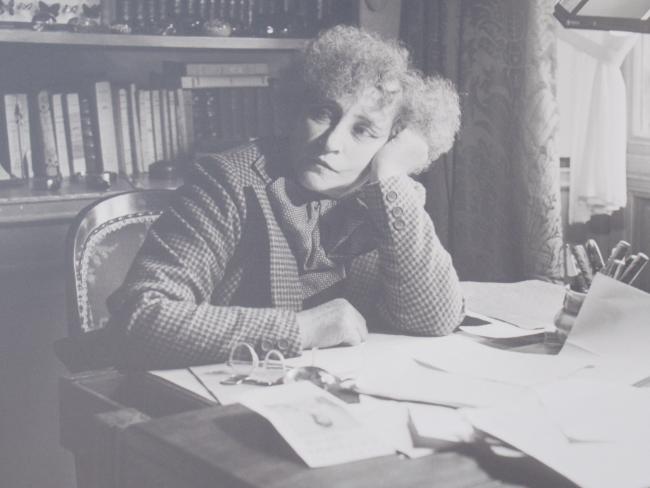
Exhibition at the Palais Royal, Colette. Photo: Marian Jones
Lead photo credit : Cour d'Honneur, Palais Royal. Photo: Marian Jones
Share to: Facebook Twitter LinkedIn Email
More in Palais Royal
Related Posts
By Marian Jones