
Paris: Creative Approaches to Meeting Basic Human Needs

Cafe life in Paris. Photo: David Griff
Paris works her magic through many mechanisms – beauty, sustainability, constant evolution, the message that pleasure is important. One more way in which the city welcomes visitors and residents alike is through attention to and creative solutions for our universal human needs. Here are a few examples that have intrigued me.

Leaping dancer, street art in the 13th. Photo: David Griff
People need rest.
Whether shopping, touring, or walking around the city, people tire and may need to rest. A Parisian tradition is to provide as long a respite as one requires along with a drink at a sidewalk café – coffee, tea, wine, beer, an aperitif or perhaps a citron pressé or an Orangina. No respectable bar or brasserie would consider pushing a client on his or her way once a glass or cup is empty. The unspoken assumption is that the person who paused for restoration will move along once the need is met.

Green spaces in Paris. Photo: David Griff
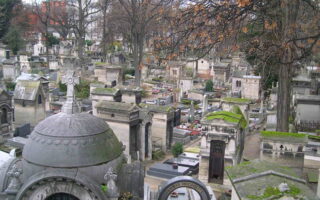
Parks are everywhere. Large parks, small parks, a strip-of-grass-with-benches parks. The notion that people may need to stop and rest is implicit in their placement all over the city. Large parks and gardens may be destinations in their own right – the Tuileries or Jardin du Luxembourg, Parc Monceau or Parc des Buttes Chaumont, the Bois de Boulogne, Bois de Vincennes or Parc de la Villette. But equally inviting are the benches appearing along Cour de la Reine, on the Square Jean XXIII behind Notre Dame or a couple of blocks across the river at the tiny Square André Lefevre on rue de la Parcheminerie.

Seating in Beaugrenelle mall. Photo: David Griff
Shopping can be exhausting. Not only have les grand magasins added opportunities for weary shoppers to rest their tired eyes and feet from time to time throughout the stores, but the relatively new Centre Commercial, Beaugrenelle, Paris’s interpretation of the in-city shopping mall, has numerous comfortable chairs in prime real estate surrounding the central stairwells and throughout the galleries so that visitors can stop when they need to, rest while awaiting a friend, or take a few minutes to reconsider their next destination.

Resting on a park bench. Photo: David Griff
People need to be able to care for their families.
Those who are young and agile spontaneously make room on a bus or the metro for those who are less mobile – a child in a stroller or parental arms, the disabled, pregnant, or aging. Signs on public transportation assign specific spots for those with needs for such extra support and explicitly encourage “civilité”, but the alacrity with which a young person will relinquish a seat or assist with a stroller never ceases to impress me. This recognition that people have individual needs and those who can help others runs deep.
Add the centers for the care of children that dot the city, ample resources for handicapped and aging people, and other simple supports for working parents, and the message is clear: People are connected and we must care for one another. Families are welcome into public spaces like the Left Bank along the quais between Orsay and Alma, visiting low-cost or free marionette shows, ateliers in museums during vacances scolaires, and municipal events like parades and fireworks displays.

Inside the metro. Photo: David Griff
People need to get from here to there.
Although Parisians are well-known for walking when a strike disrupts traffic, a manifestation requires rerouting, or the weather invites extended contact with the ground, sometimes distances or time make their own demands. Public transportation around Paris is ample but far from the only option. In recognizing the human need to toggle between far-flung locations, everything from scooters to segways can be spotted on Parisian streets. Bicycles abound; motorcycles have parking areas; an expanding tram system helps people connect to other people and to resources that lie beyond the périphérique. On New Year’s Eve, when safe travel might be compromised by an alcohol haze, fares are suspended on the metro.

Cafe scene in Paris. Photo: David Griff
People need nourishment for the body.
Paris may lead the world in number of restaurants (and other food opportunities) per capita. That may be impressive – but far more so is the quality of the food. Open-air markets with fresh produce and other products operate year-round across the city. Local bakeries provide fresh and affordable baguettes throughout the day. “Fast-food” remains less appealing to most French than a seated moment, whether a light bite or a meal in the company of friends. The importance of good nutrition and sharing meals as an opportunity to be fully human is emphasized from a young age, as seen in French school lunches.

Music in the streets. Photo: David Griff
People need nourishment for the soul.
Paris is a capital of creativity in so many domains of human expression beyond the culinary – especially the arts, whether visual or performing, architecture or design, fine or applied, as well as technology and urban planning. Whether inspired by others’ accomplishments – be they displayed in the Louvre or on the side of an apartment building in the XIIIème – people are also empowered to express their own internal lives and longings. On the ground, an artist “paints” using dirt; on a bridge, a trio plays Bach; on the steps of Montmartre or in the Centquatre, young people break-dance. Everywhere, wardrobes announce individuality. People pick up the colors of the moment out of the ether and add a scarf or hat to welcome the season.

Street art in the 13th arrondissement. Photo: David Griff
People need to deal with waste.
No garment is cut without scraps of fabric left behind; no meal is prepared without the scrapings of peels and bones left behind. A culture of recycling and reusing what can find a new application was explained at the first Cordon Bleu cooking class I attended! Today the trimobile circulates among Parisian neighborhoods, allowing citizens to donate what no longer serves them to others who might find use for an item; recycling bins are nearly as plentiful as the transparent garbage bags; public toilets are a little everywhere to allow sanitary disposal of human waste; and buildings are renovated rather than razed. After the holiday season, Christmas trees are collected by the City in an orderly fashion, permitting proper disposal. The same respect that greets human aging is offered to material goods, as people appreciate the wisdom of investing in sustainability. Resale shops proudly display fine apparel ready for a second life.

The Trimobile to recycle among neighbors. Photo: David Griff
People need pleasure.
Finally, there is “le Plaisir”. We humans are hard-wired to experience pleasure, whether the joy of recognizing an experience associated with happiness in the past, or the curiosity associated with surprise or novelty. “Le Plaisir” – de lire, de la musique, de boire, de manger, de n’importe quoi is a subtle underpinning of French culture throughout life. Wanting to provide experiences that bring smiles to one another forms the basis for dressing to bring pleasure, cooking to spark delight, engaging in conversation that actually expands thoughts and perceptions rather than simply impresses.

Music in the streets. Photo: David Griff
Lead photo credit : Cafe scene in Paris. Photo: David Griff
Share to: Facebook Twitter LinkedIn Email
Related Posts

REPLY