
Rosa Bonheur: The Artist Who Inspired the Guinguettes in Paris

In 1857 the Paris Prefecture of Police issued Rosa Bonheur une permission de travestissement, allowing the then 32-year-old artist permission to wear men’s clothes in public.
Cigar-smoking Rosa, with her cropped hair and masculine dress, had always lived a non-traditional life, stemming in no small part from the philosophy of her father, who encouraged her career as an artist and buoyed her independence.
Also an artist, Rosa’s father Oscar-Raymond Bonheur was a Saint-Simonian – a member of a political group which promoted a system of socialism. They aspired for equality of women and men and the abolishment of class distinctions. Rosa’s defiant personality placed her as an early feminist. She wrote that “To [my father’s] doctrines I owe my great and glorious ambition for the sex to which I proudly belong and whose independence I shall defend until my dying day.”
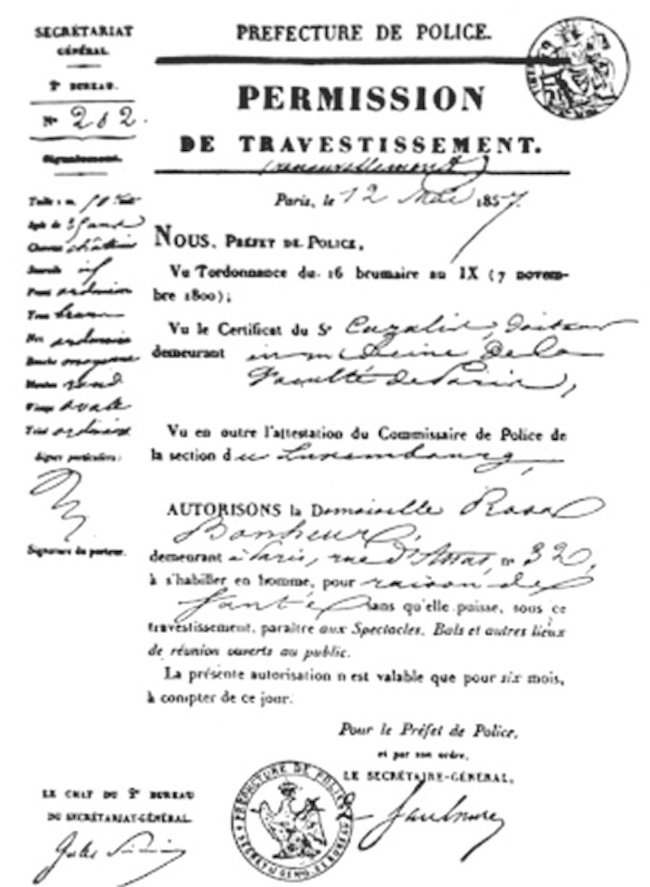
Rosa Bonheur’s Permission de Travestissement.
Rosa Bonheur was born in 1822 in Bordeaux, and died in Thomery, near the famed artists’ retreat of Fontainebleau, in 1899. She grew into a prolific painter and sculptor of animals. She was so precocious under her father’s tutelage that by the age of 14 Rosa began painting copies at the Louvre and first exhibited at the exalted Paris Salon in 1841 at age 19. By 23 Rosa had exhibited 18 works at the Salon. She was part of the Realist movement that emerged in Europe in the 1840s. In 1848 she received a lucrative commission from the French State for Ploughing at the Nivernais (1849), now housed at the Musée d’Orsay. This Realist painting was inspired by George Sand’s rustic novel La Mare au Diable of 1846. The writings of George Sand another non-conformists had a great effect on Bonheur.
Bonheur was known as an peintre animalier for demonstrating an affinity for animals in her art. Her amazingly precise depictions of animals stemmed from her direct observation of the nature around her and was aided in no small part by her meticulous draftsmanship. To gain this intimate knowledge, Bonheur kept a small menagerie, including, as time passed, rabbit, squirrels, horses, lions, and even an otter. She frequented horse fairs and abattoirs and dissected animals to add to her familiarity of animal anatomy.
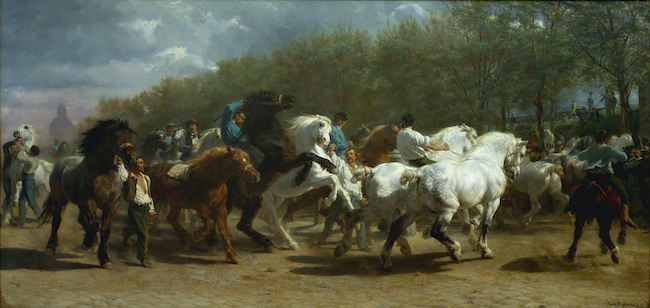
Rosa Bonheur exhibited regularly at the Salon until 1855. The peak of Bonheur’s career was Le Marché aux Chevaux (The Horse Fair), which she started in 1851 and after 18 months of preparation and research submitted to the 1853 Salon. The immense work, measuring 2.45 by 4 meters, is based on numerous drawings done at the horse market near Salpêtrière and shows her talent for anatomical accuracy. After its triumphant showing at the Paris Salon, the painting went on tour in Great Britain and America, where her paintings were known to sell well. Soon The Horse Fair was widely distributed as a print reproduction. In 1887 American rail magnate Cornelius Vanderbilt II bought the work for £53,000 and donated it to the Metropolitan Museum of Art in New York City.
Rosa lived at her Montparnasse studio at 56 rue de l’Ouest with her companion Natalie Micas. But after 1860 Bonheur withdrew from the Paris art world and settled in the Chateau de By on the outskirts of Fontainebleau with Micas. Bonheur received the Legion d’honneur from Empress Eugénie in 1865, the first woman to be so esteemed.
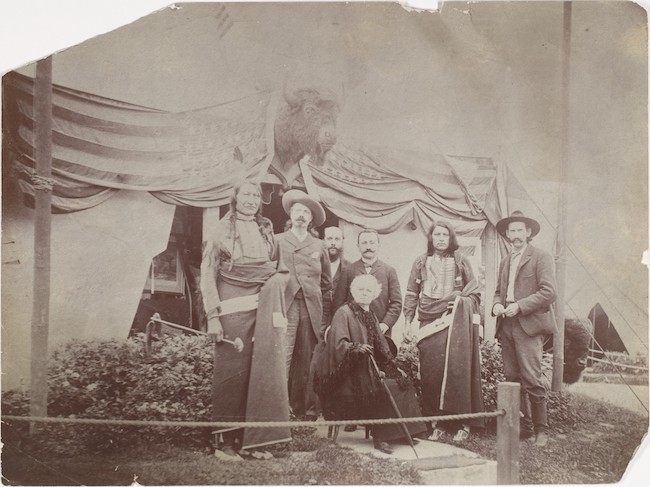
Rosa Bonheur, Bufalo Bill Cody at the Paris Exposition Met Open Acess public domain.
Although an artist famous during her own lifetime, Bonheur was not universally admired by contemporary critics. “She painted like a man,” was the predictable dissent. So in France there was a mixed critical reception to her. But her success in England, her eccentric lifestyle, and masculine dress made her such a curiosity that a doll was made in her likeness in the 1870s.
Independent and financially secure, Rosa Bonheur painted steadily and entertained celebrities like Buffalo Bill Cody whose portrait she painted in 1889 when he brought his Wild West Show to Paris. The painting is now on exhibition at the Whitney Western Art Museum at the Buffalo Bill Center of the West in Cody, Wyoming. In the mid-1890s American-in-Paris portrait painter Anna Klumpke, inspired by Rosa Bonheur since she was given a Rosa doll in the 1870s, sought Rosa out in order to paint her. They became companions and lived together for the final year of Rosa’s life.
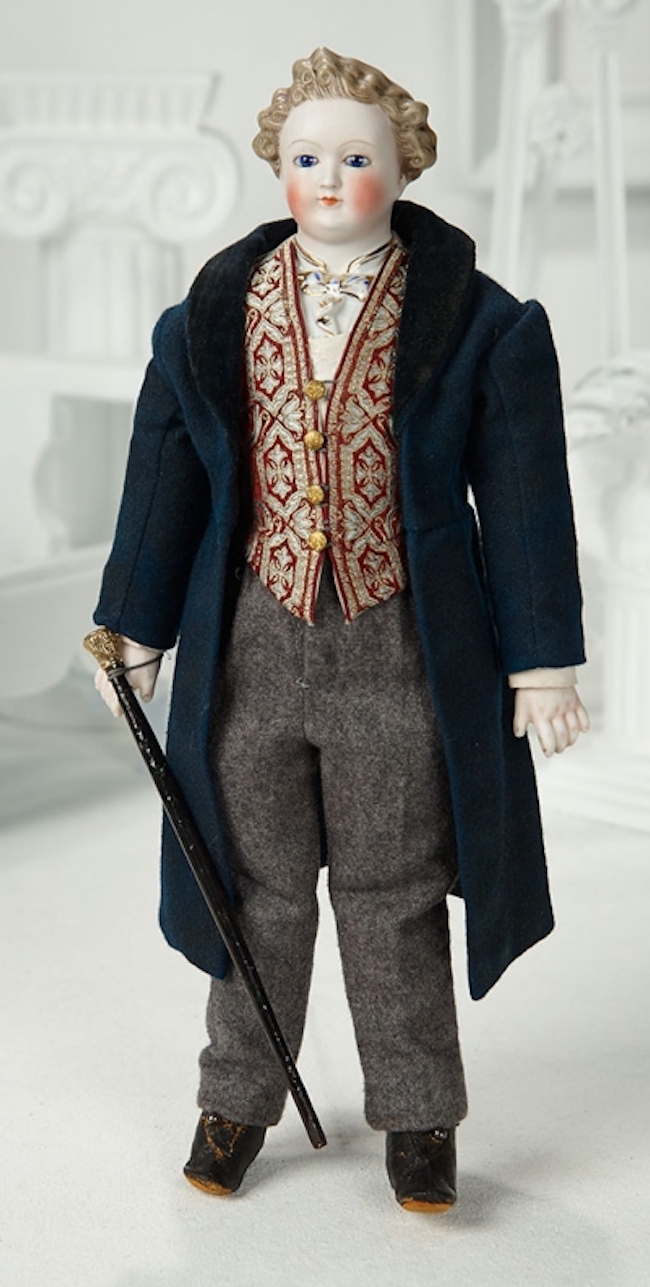
The Rosa doll
Pink Happiness
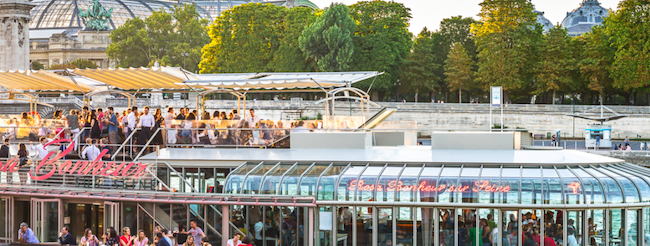
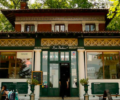
Now Rosa Bonheur is honored with a chain of Paris guinguettes that bear her name. Two quayside bars, a park-side pavilion, and a new crêperie are a tribute to Rosa the person and less Rosa the artist. They are a tip of the hat to the bucolic “free” lifestyle – a life without borders – that Rosa promoted. The name Rosa Bonheur, which approximately translates to “Pink Happiness,” is now attached to the popular bars, two set on atmospheric barges on the Seine, one at the foot of the Musée d’Orsay, the other near to the Impressionist retreat of Asnières-sur-Seine, and a third set in the Buttes-Chaumont Pavilion. The Rosa Bonheur Crêperie in the Jardin des Tuileries is positioned to the far west of the park but within walking distance of the neighboring Louvre which first exhibited Bonheur’s award-winning Ploughing at the Nivernais and the Musée d’Orsay which houses it now. All Rosa Bonheur locales are relaxed spaces for Parisians and flanêurs of all persuasions to share in the good vibe. There’s wine and pizza beside the Seine or tapas, Pétanque, and games for children in the more pastoral of the settings. There are always DJs on hand to set the opportunity to drink, dance, and eat.
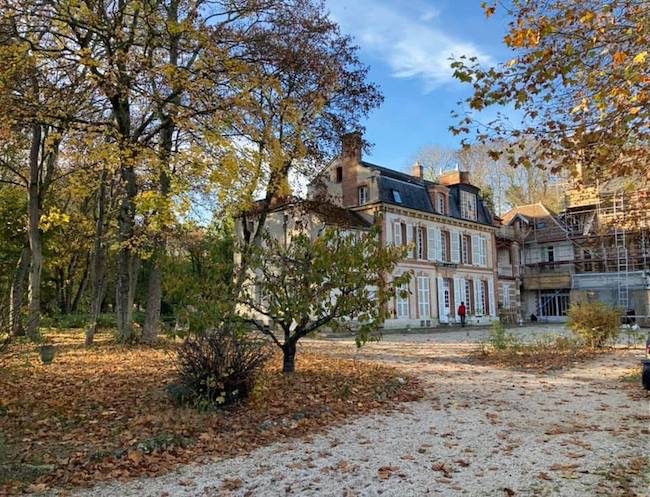
Château de Rosa Bonheur. Photo credit © Musée Atelier Rosa Bonheur
DETAILS
Website: www.rosabonheur.fr
Rosa Buttes
Parc des Buttes Chaumont
2 avenue de la Cascade
Located in the Parc des Buttes-Chaumont at 1 rue des Botzaris, 75019
Rosa Seine
37 Quai d’Orsay, Port des Invalides, 75007
Rosa Ouest
20 Quai du Docteur Dervaux, Pont d’Asnières
92600, Asnières-sur-Seine
Rosa Crêperie
Jardin des Tuileries
9, place de la Concorde, 75001
Access by the gate at Place de la Concorde
Lead photo credit : André Adolphe-Eugène Disdéri (French - (Rosa Bonheur) - Google Art Project. Photo credit © Wikipedia, public domain
Share to: Facebook Twitter LinkedIn Email
Related Posts
REPLY