Metro Magic: Show Me the Money
This is the seventh in a series of stories about the wonders of the Paris Metro System.
Walking through the Pont Neuf/La Monnaie metro station, I can’t keep Jerry McGuire out of my head. Show Me the Money! Show me the money!
The iconic scene in the film keeps appearing. Tom Cruise (sports agent) and Cuba Gooding, Jr. (football star) are in a “Show Me the Money” shouting match that escalates to crescendo, sealing their relationship.
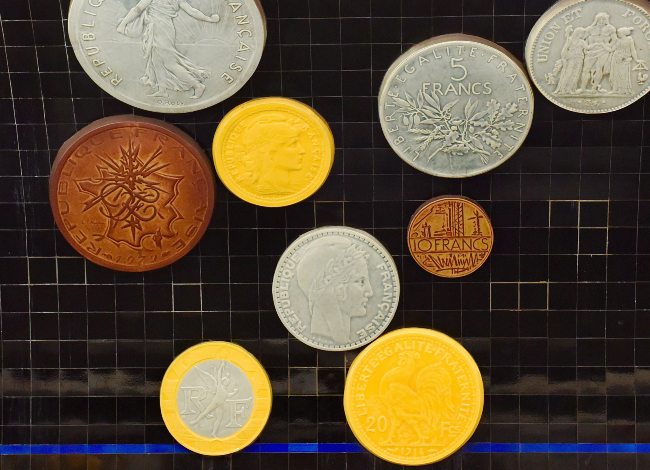
Why this image? Because money is in the air in this vaulted-ceiling Line 7 station. Huge ceramic replicas of French coins dance on the ceiling and cascade down the walls.
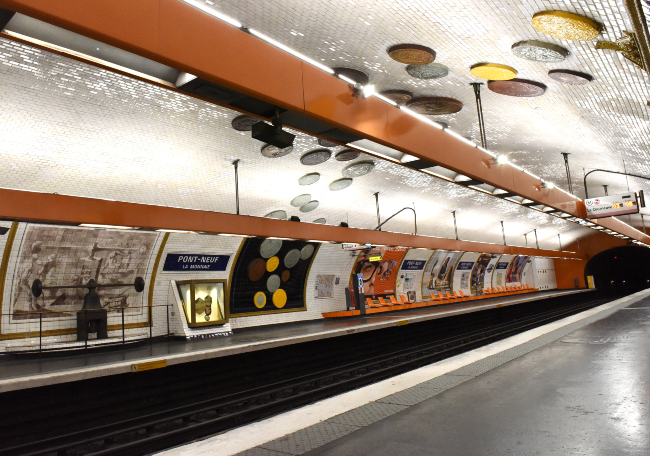
Money is everywhere in the Pont Neuf/La Monnaie metro station. Photo by Meredith Mullins.
Of course, money isn’t everything; but, because the Pont Neuf/La Monnaie station is near the Monnaie de Paris (the Paris Mint), it becomes a feature of this station design.
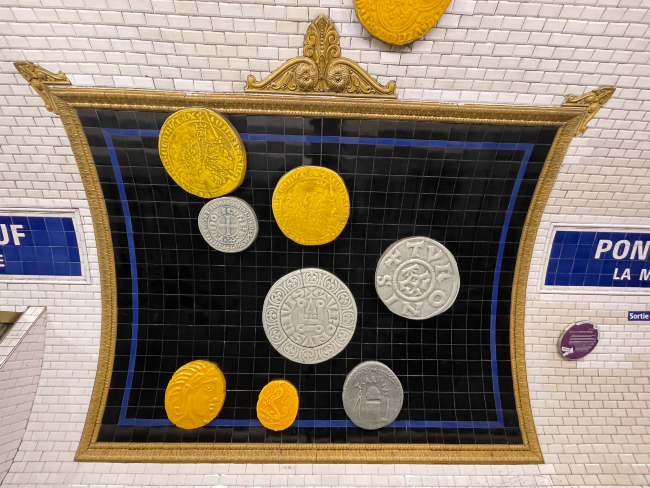
Replicas of the old coins are displayed in the showcases. Photo by Meredith Mullins
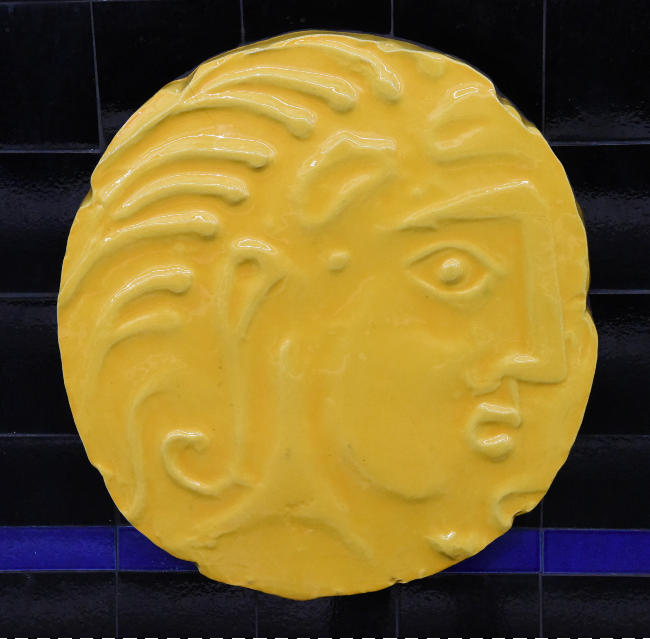
The artistry of the coins is worthy of study. Photo by Meredith Mullins.
La Monnaie de Paris
The focus on the Paris Mint and the coins produced over the past 1150 years is well deserved. The mint (just across the Pont Neuf from the metro exit) is the oldest working Paris institution and continuous coin producer in the world. The mint is housed in the Hôtel de la Monnaie on Quai Conti, along with the Musée de la Monnaie de Paris.
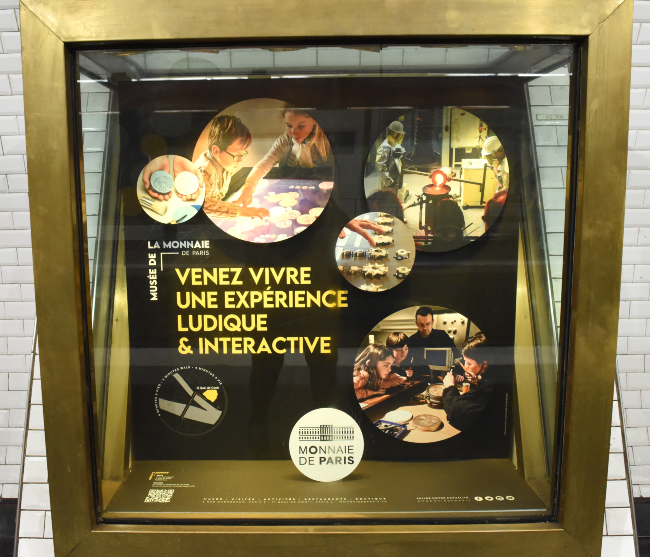
In the station, you’ll find a preview of what’s happening at the Musée de la Monnaie. Photo by Meredith Mullins.
At the museum, as well as in the metro station, you can learn about the history of French coins. Special coins and medals are still made at the mint, while everyday coins are made at a second site in southwest France.
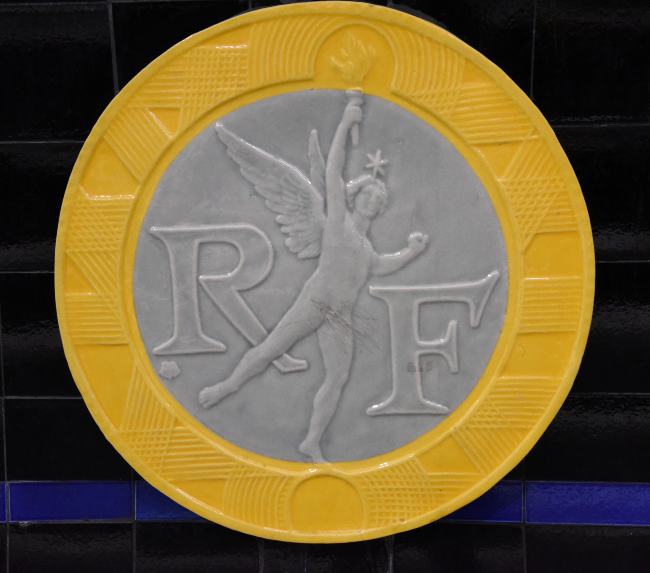
The Génie de la Liberté appears on many different coins. Photo by Meredith Mullins
The giant replicas suggest the artistry and historic significance of coins, dating back to the beginning of the mint in the year 864. You’ll see recurring designs, such as the fleur de lis (associated with the French monarchy), the cross of the Knights Templar (warriors who were dedicated to guarding pilgrims in the Holy Land), La Semeuse (she who sows) and, of course, national symbols of the French Republic — the Gallic rooster, Marianne, and the Génie de la Liberté (Spirit of Freedom), which tops the monument in the Place de la Bastille.
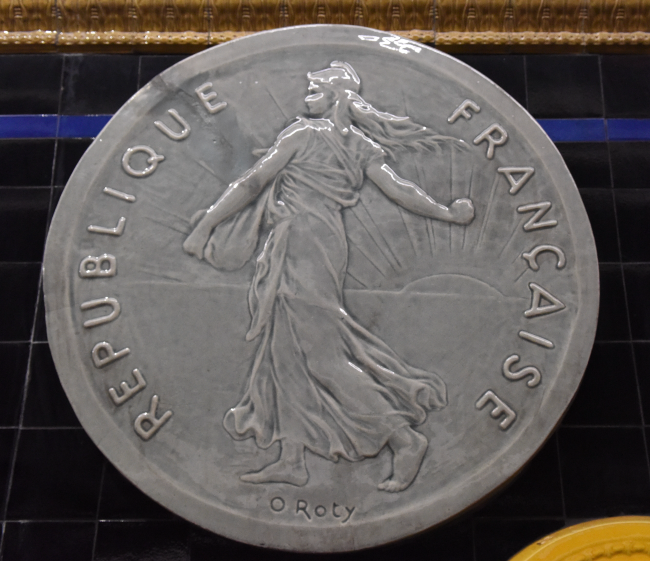
La Semeuse (she who sows) appears frequently. But what is she sowing? Some say ideas. Some say anarchy. Some say freedom. Photo by Meredith Mullins.
Also on display is a historic coin press, backed by a tiled graphic showing the press in action with other coin activities of the time.
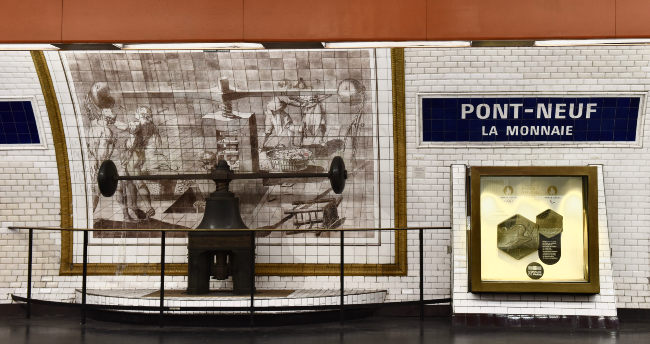
The historic coin press and tiled history of the coin production of the times. Photo by Meredith Mullins.
There are also cases featuring new collectors’ coins of the day (for example, coins honoring sports and the 2024 Olympics — made, for the first time, in hexagonal format. A great holiday gift?
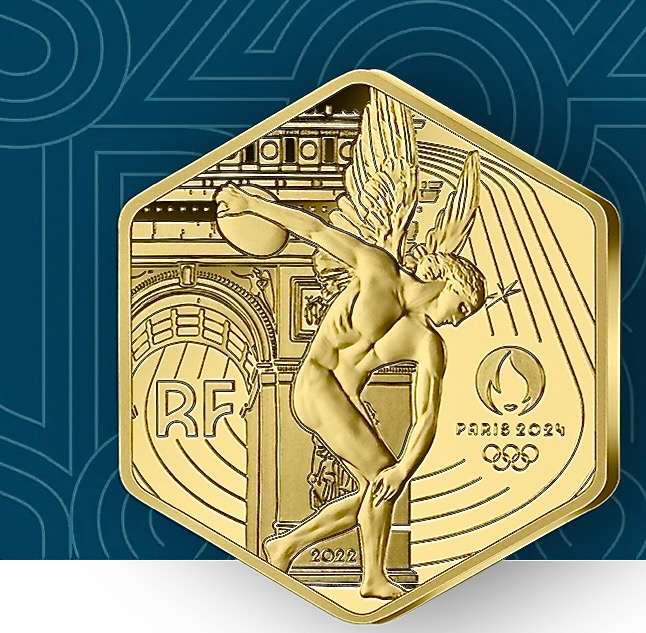
The perfect holiday gift … and tribute to the Paris 2024 Olympics. Photo courtesy of the Musée de la Monnaie.
Le Pont Neuf
The other main attraction near this station is the Pont Neuf, which greets you as you emerge from underground and takes you across the Seine (and the Île de la Cité) to the Left Bank.
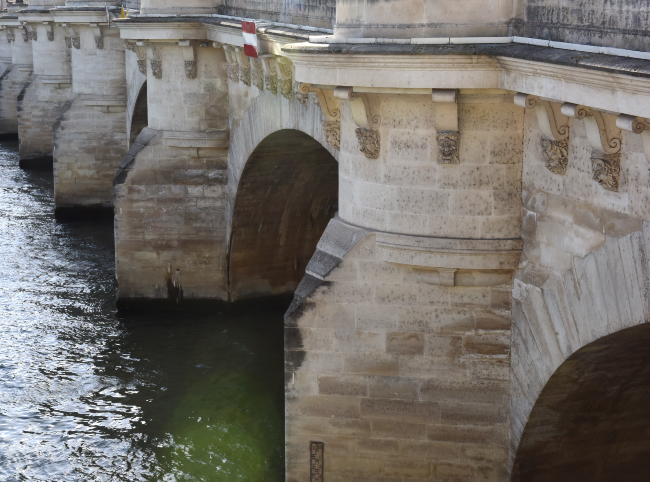
Le Pont Neuf. Photo by Meredith Mullins.
This historic bridge, with its cozy alcoves and 381 carved stone masks, is the oldest bridge in Paris (with its ironic translation as “The New Bridge”). Built in 1607 (when it actually WAS the “new” bridge), it was inaugurated by Henri IV. It was the first bridge in Paris to have an unimpeded view of the Seine (no houses on the bridge) and has since been the focus of films (such as Les Amants du Pont Neuf) and art installations, such as Christo’s wrapping of the bridge in 1985 with a golden silky fabric.
The Station Design
The Pont Neuf/Monnaie de Paris station was built in 1926, as Line 7 was extended from Palais Royal to Pont Marie. As with most things in Paris, it was redesigned over time. For this station, architect Paul Andreu and designer Joseph-André Motte created the new motif in the 1970s, including the orange “shell” chairs, the fluorescent light strips at the edges of the platforms, and the beveled tiles of the walls.
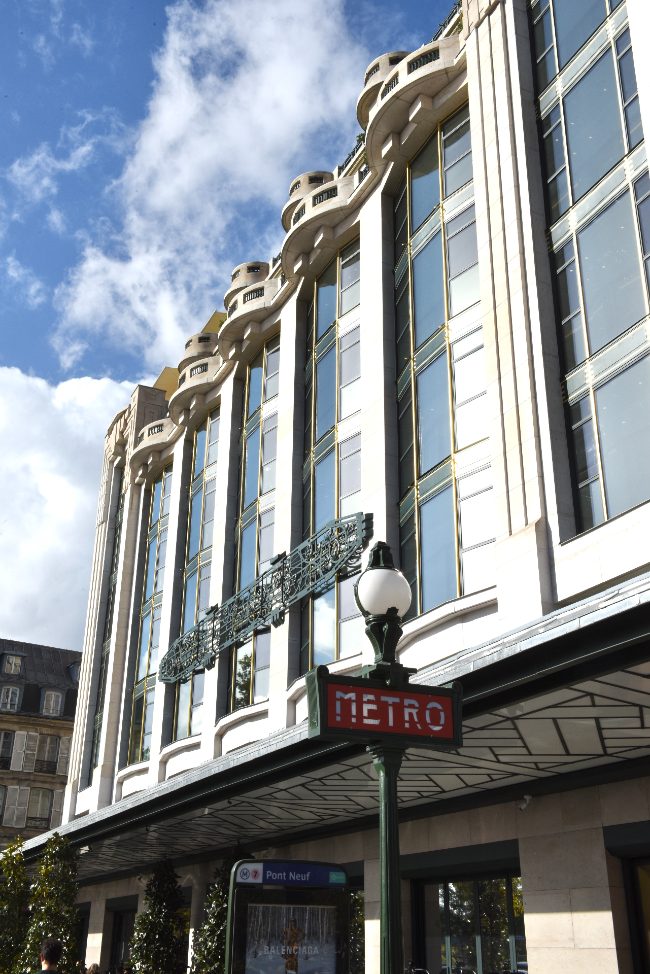
La Samarataine. Photo by Meredith Mullins
The station is worth a visit for its lessons of monnaie history as well as for its surroundings. Adding to the iconic places in the neighborhood is the newly remodeled La Samarataine department store, hotel, and restaurant, just at the top of the station stairs. Another reason to shout “Show Me The Money.”
The Musée de la Monnaie is open Tuesday through Sunday from 11 a.m. to 6 p.m.
La Samarataine department store is open every day from 10 a.m. to 8 p.m.
The Pont Neuf is open . . . all the time.
Lead photo credit : Photo by Meredith Mullins
Share to: Facebook Twitter LinkedIn Email
More in Art, ceramics, coins, culture, La Monnaie de Paris, La Samaritaine, le pont neuf, Metro magic, Musée de la Monnaie, Pont Neuf
Related Posts