
Metro Magic: Bastille, A Revolutionary Station
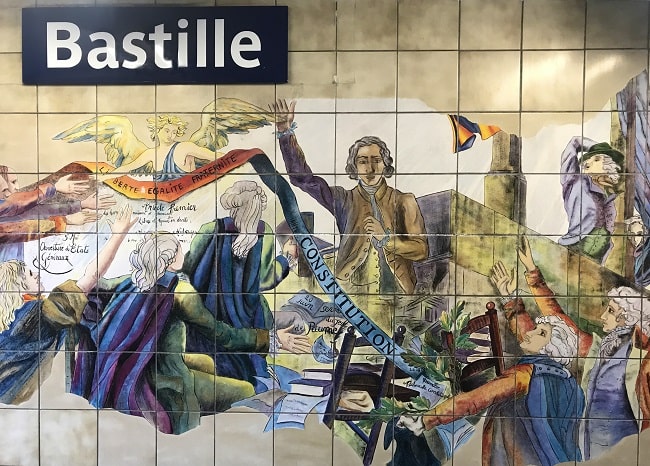
This is the second in a monthly series of stories about the wonders of the Paris Metro System. Read the first one here.
The mere mention of the word Bastille often conjures revolutionary thoughts.
As you walk or rumble through the Bastille Metro Station, you may only be thinking of the fastest way to get where you’re going — using Bastille’s convergence of Metro Lines 1, 5, and 8. But you may also be getting some revolutionary vibes from the layers of history that are a part of this corner of Paris.
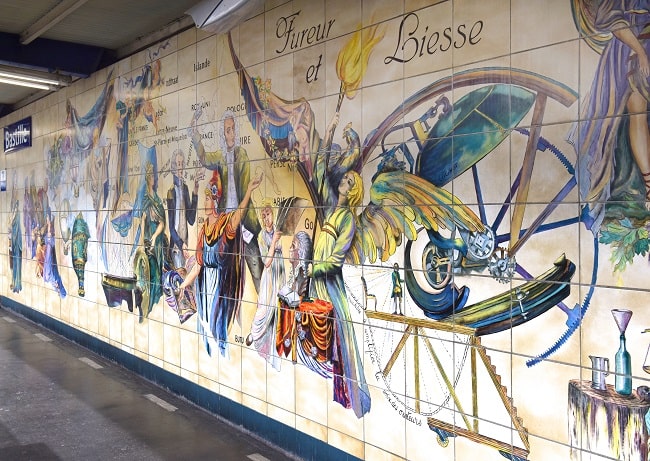
The Line 1 Quai at Bastille. Photo © Meredith Mullins.
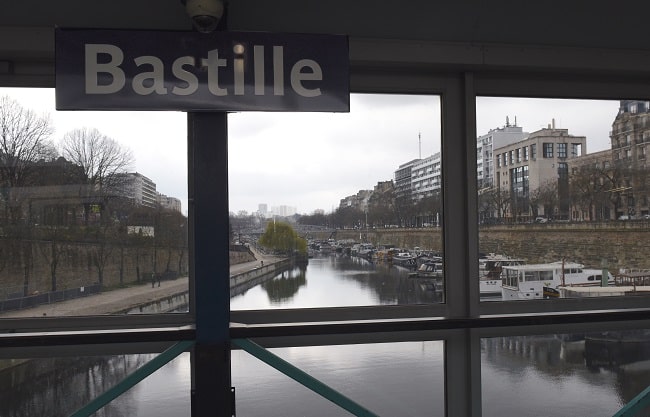
Since you’re above ground on Line 1 at Bastille, you can look out over the Bassin de l’Arsenal. Photo © Meredith Mullins.
Storming the Bastille
The former site of the Bastille prison, just outside the metro station, was where the French revolution of 1789 symbolically began. Discontent had been stirring for years with the French monarchy (King Louis XVI), related to the feudal system, taxation, and overarching economic difficulties. However, the “storming of the Bastille” on July 14, 1789 was a pivotal moment.
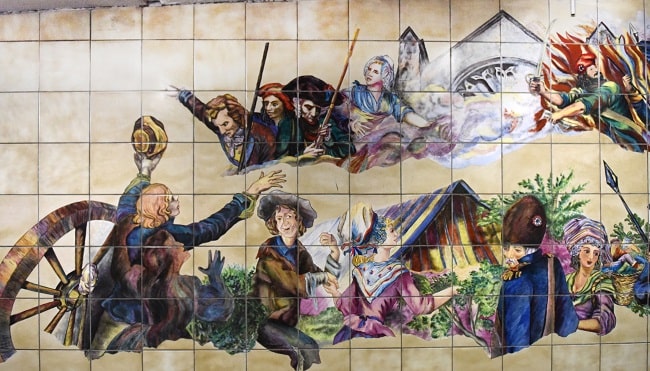
Storming the Bastille. © Meredith Mullins.
The prison was seen as a symbol of royal tyranny. An angry crowd of close to 1000 protesters gathered on July 14 and attacked the prison, searching for weapons and gunpowder. After hours of fighting, the prison troops surrendered, the seven prisoners were freed, and, ultimately, the Bastille Governor in charge of the prison was taken to the Hôtel de Ville and beheaded. The revolution had begun.
Commemoration of Bastille Day (July 14/Quatorze Juillet)
To commemorate the 200th anniversary of this transformative day, ceramic artists Liliane Belembert and Odile Jacquot created a multi-paneled tiled mural in 1989 on the walls of the Line 1 quais.
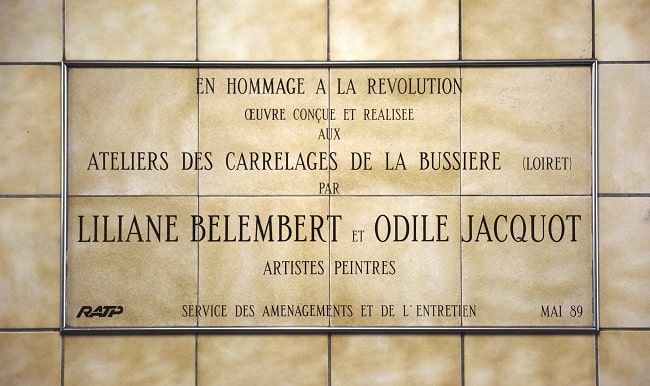
Commemoration of Bastille Day. © Meredith Mullins.
The mural shows the complexities of the era, from the Age of Enlightenment and the liberation of ideas to the revolution itself. What better way to pass the minutes waiting for a metro than to be surrounded by this important time in French history?
The Age of Enlightenment, or Age of Reason, was an era of exploration, discovery, and new ideas. Politics, philosophy, science, and communication were shifting radically. The great thinkers were immersed in “a chaos of clear ideas,” as Voltaire described it. The time was right to remake society.
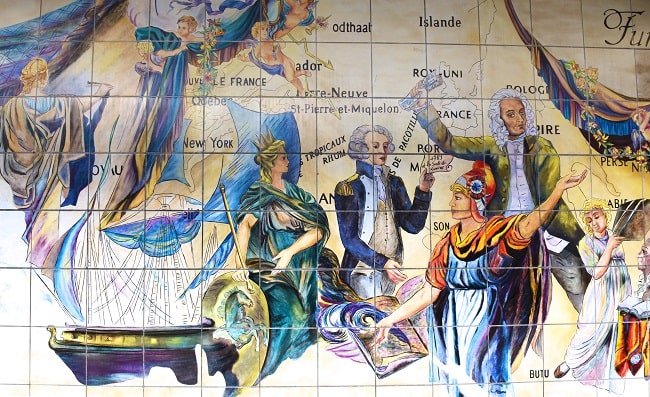
France explores new worlds; and Voltaire, in a starring role, raises his writing in a clenched fist of solidarity with a new age. Photo © Meredith Mullins.
The mural pays tribute to the first hot-air balloons from 1783, created by the paper-manufacturing Montgolfier brothers. The visual story features the elegantly ornate blue and gold balloon created in collaboration with wallpaper designer Réveillon —decorated with signs of the zodiac, sparkling suns, and the omnipresent French fleur-de-lis.
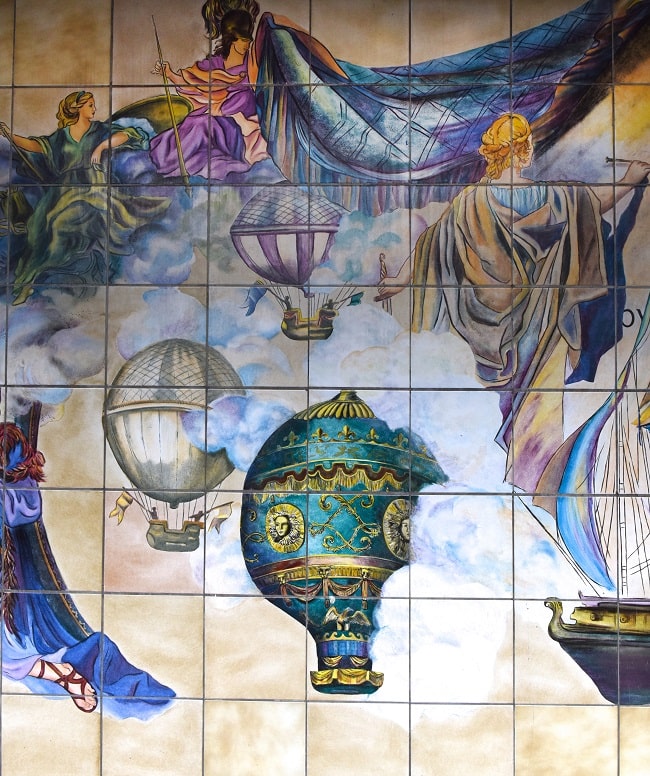
The invention of the hot-air balloon in 1783. Photo © Meredith Mullins.
Although a mystery figure’s head is covered by the practicalities of metro navigation, science, botany, and education play a key role in this segment of the mural. The person — who clearly needs a new publicity agent — could be Jean-Jacques Rousseau, since his treatise on education (l’Émile) can be seen in the lower corner. This important writing was influential in offering proof that human morality could survive in a corrupt society.
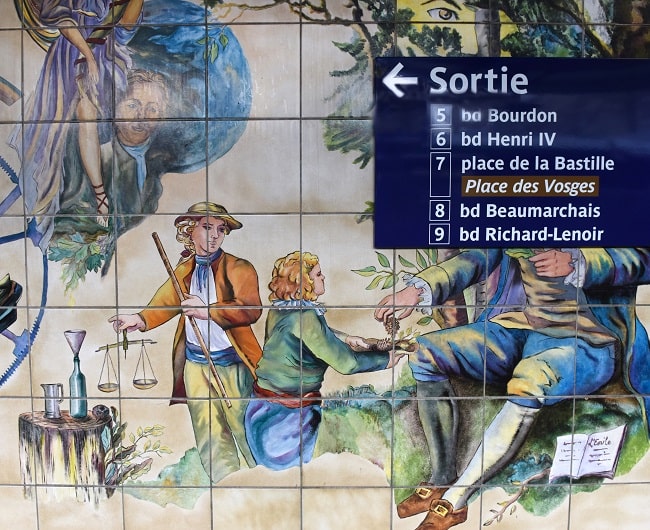
The importance of science, botany, and education. Photo © Meredith Mullins.
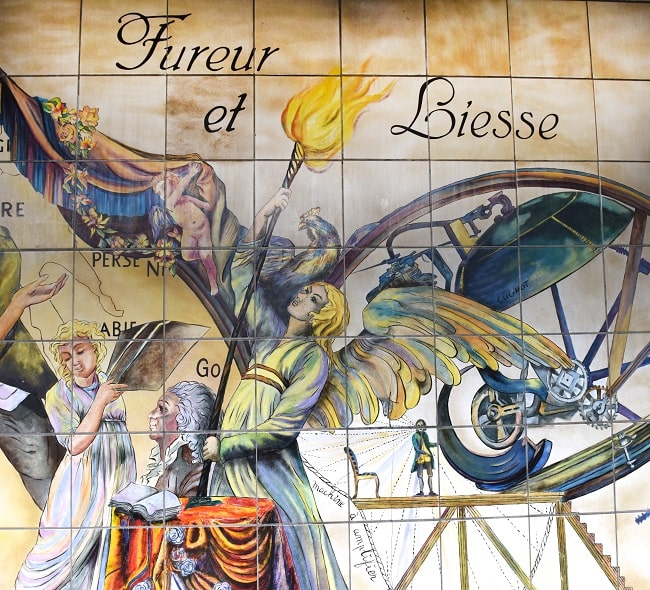
The fury and jubilation (fureur et liesse) of the pre-revolution period, as the voices of reason were amplified. Photo © Meredith Mullins.
We see the pride and the struggles of the commoners (the Third Estate), including the bread sellers, the street musicians, and the roving merchants (les cris de Paris) who roamed the streets and added to the bustling atmosphere by calling out their wares.
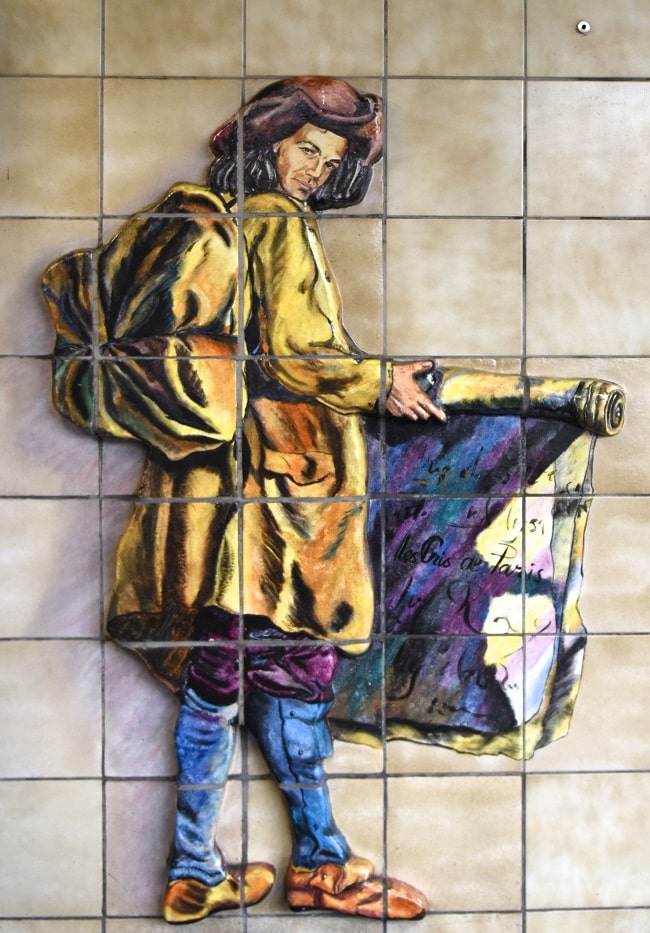
The (good-looking) roving merchants, with their familiar street cries (les cris de Paris). Photo © Meredith Mullins.
Food shortages — especially grain shortages — stoked protests and anger among the lower classes. Bread was in short supply. Although historians have confirmed that Marie Antoinette probably never actually said “Let them eat cake” in response to the bread shortage, the issue was a critical one.
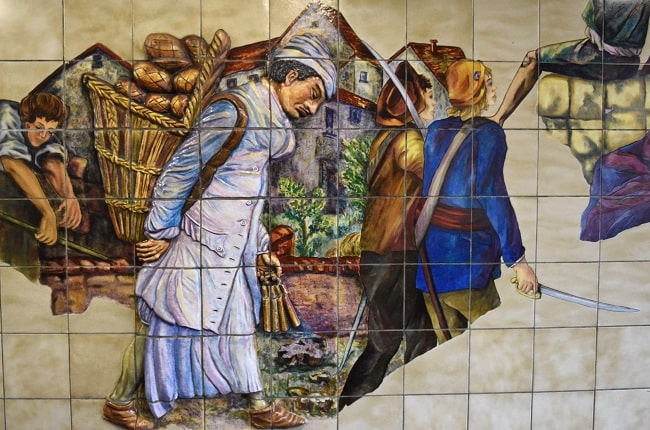
Bread was a valued commodity. Photo © Meredith Mullins.
We see Marianne — a prominent symbol of the French Republic — in several cameos, as a message of freedom and the personification of liberté, equalité, et fraternité.
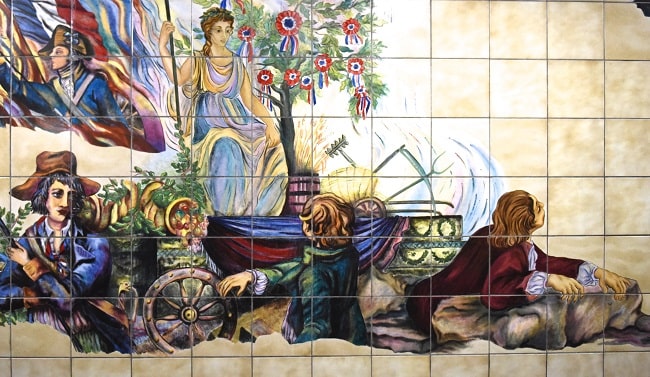
Marianne—originally a goddess of liberty—represents freedom from all forms of oppression. Photo © Meredith Mullins.
The revolution lasted for 10 years, with thousands of people losing their life. Louis XVI and Marie Antoinette were both killed by guillotine in 1793. However, the painful period led to a new form of freedom and equality in France.
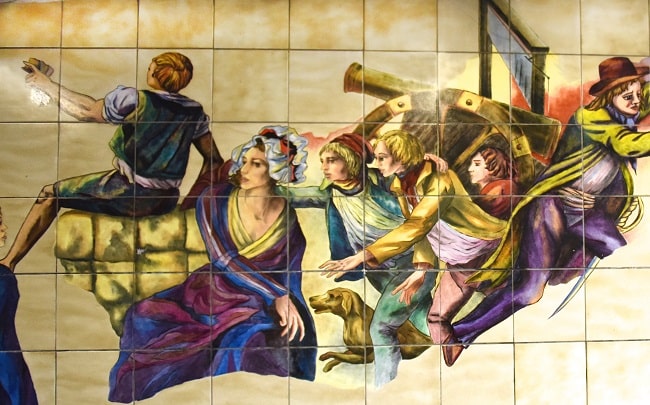
A painful period that ushered in a new form of society. Photo © Meredith Mullins.
The Remnants of History
After reflecting on the colorful sequences of the mural on both quais of Line 1, take a one-minute walk to Line 5 toward Bobigny/Pablo Picasso. At the end of the quai is a display about the Bastille prison, as well as part of the original wall of the prison’s rampart (the countrescarpe).
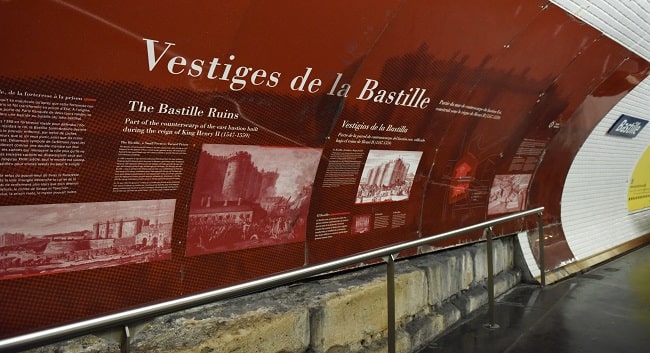
During the excavation of the Line 5 metro, this segment of the Bastille prison rampart was discovered. Photo © Meredith Mullins.
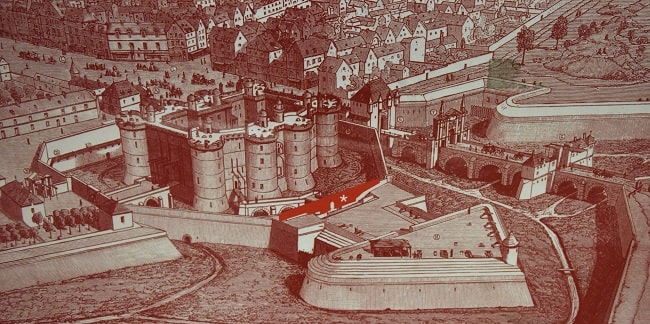
The display includes a diagram of the Bastille prison, including a note about where the segment of wall that you see was located on the prison grounds. Photo © Meredith Mullins.
You can also step outside the station to the open-air Place de la Bastille. The prison was destroyed in 1789, and the stones were spread throughout Paris as symbols of the revolution. Some were used to build the Pont de la Concorde. The base of one of the prison towers was moved to the Square Henri-Galli, just a few minutes away from Bastille.
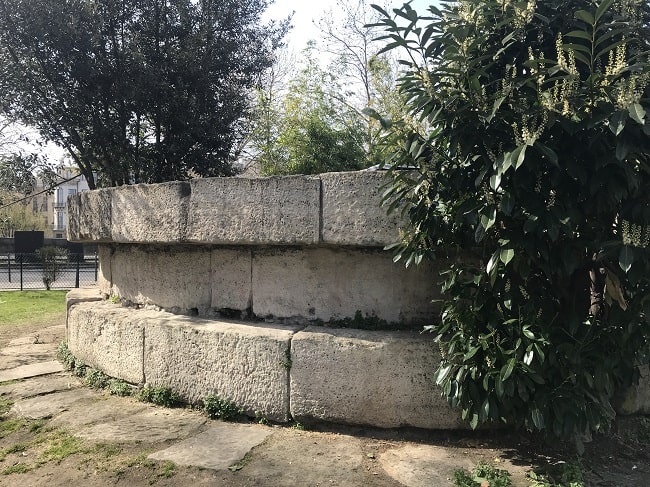
A remnant of the Bastille prison tower at Square Henri-Galli. Photo © Meredith Mullins.
Now the July Column rises tall where the prison once stood, paying tribute to another July revolution — the Revolution of 1830. All in the name of freedom.
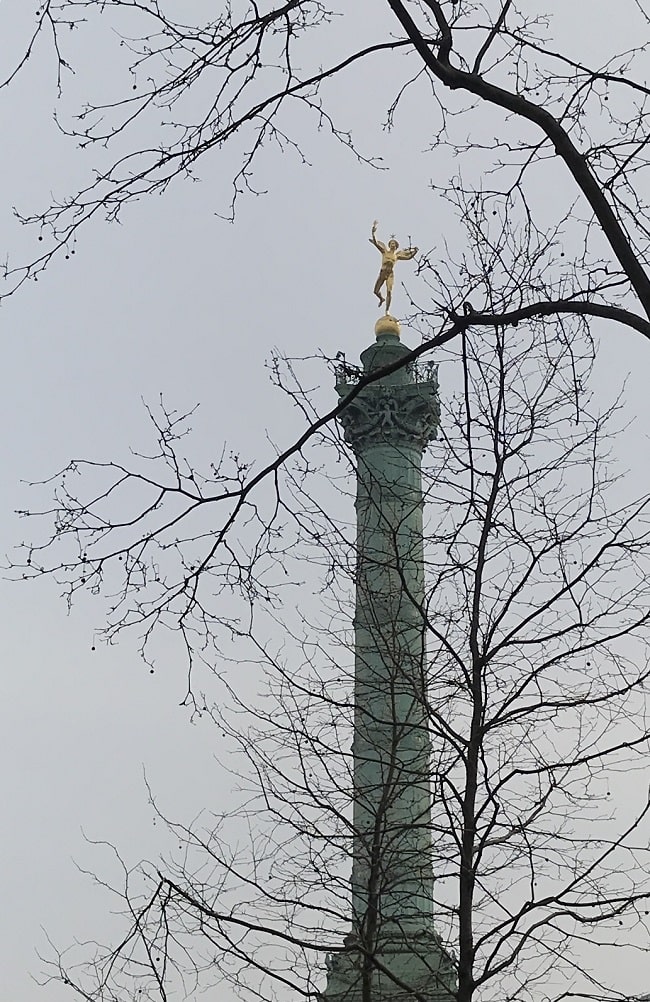
The Colonne de Juillet at Place de la Bastille. Photo © Meredith Mullins.
A Metro Education
As in the first edition of Metro Magic about the Parmentier metro station and how the potato gained popularity in France, the Bastille station does not disappoint. The presentations can lead you on a French history treasure hunt.
The theme of Metro Magic is clear — you can learn a lot while waiting for a train.
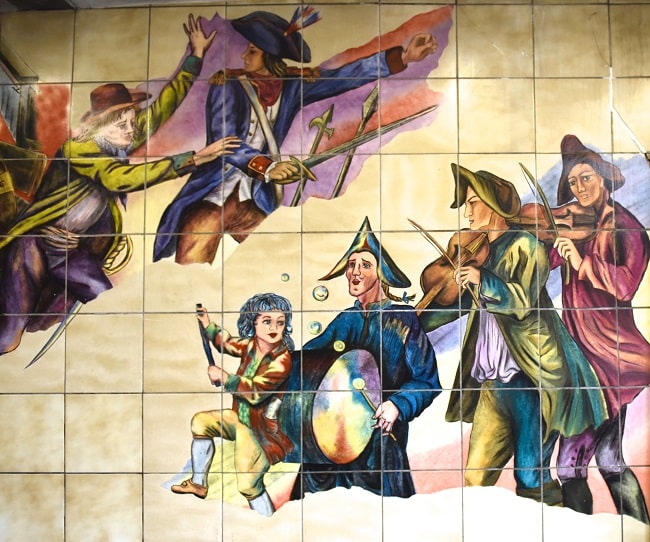
Let the music of freedom play on. Photo © Meredith Mullins.
Lead photo credit : Metro Magic: Bastille. © Meredith Mullins
Share to: Facebook Twitter LinkedIn Email
More in Art, histoire paris, Metro, Metro magic, Revolution, Station, train
Related Posts


REPLY
REPLY
REPLY
REPLY
REPLY