
Streets and Stories: Rue Gît-le-Cœur, the Tiny Street that Lured the Beats
Just off the bustling rue Saint-André-des-Arts in the 6th arrondissement, the rue Gît-le-Cœur is a centuries-old street that runs just 112 meters in a straight line to the quai des Grands-Augustins and the Seine.
From the beginning of the 13th century, the street was part of the stronghold of the Abbey of Saint-Germain-des-Prés. As with many ancient streets in Paris, its name has changed numerous times over the centuries, from rue Gui-le-Queue to rue Gui-le-Comte to Rue des Noyers and then Gilles-le-Queux. Gilles le Queux, was simply, Gilles the cook, so one imagines he was a pretty good chef to have had a street named after him!
View this post on Instagram
The street was badly flooded in 1910 when the Seine rose more than eight meters after much heavier than normal rainfall. Bizarrely, it wasn’t the quais of the Seine breaking their banks that caused the damage within the city, but the sewers and drains designed by Haussmann, which– unable to cope with the deluge– overflowed and infiltrated the buildings and the streets surrounding the Seine. Houses were evacuated, residents moved around by boat, but workman managed to keep the the quais along the Seine in check with hastily built levees.
At ten meters wide, the street still packs a lot of new and old establishments along its short length, and is a far cry from its rather shabby past of cheap hotels and run-down buildings.
The iconic, green Irish Pub, the Corcoran, proudly straddles the corner of rue Saint-André-des-Arts and rue Gît-le-Cœur, and the four-star Hotel Villa d’Estrées (situated at number 17) faces the charming, three-star Hotel Residence des Arts, which boasts its own adjoining French bistro, the Café Latin.
View this post on Instagram
The restaurant at number 15, Le Lutin dans le Jardin, may be suffering from the effects of COVID-19 and be temporarily closed, but The Great Canadian Pub at the other end of rue Gît-le-Cœur, fronting onto the quai des Grands-Augustins, has definitely been open and serving food as well showing sport on giant TV screens.
At number 5, the old Hôtel Séguier and Hotel O and Hôtel de Luynes were a fixture from the 16th to the 18th century, and the building was classified as an historic monument in 2006. While at number 4, the Syndicat National de la Librairie Ancienne et Moderne, established in 1914, is one of the biggest and oldest antiquarian booksellers, holding its prestigious, annual exhibition at the International Antiquarium Book Fair in the Grand Palais.
But is is of course at number 9 rue Gît-le-Cœur that 20th-century history was made.
View this post on Instagram
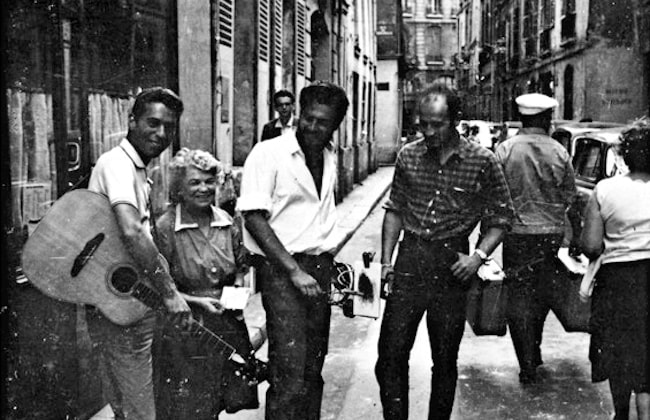
Aside from a plaque outside the rather splendid four-star hotel, the Relais du Vieux Paris, if one were looking for the infamous Beat Hotel, it would be more than easy to walk past and keep searching for a sign of the run-down, decrepit hotel ran by Monsieur and Madame Rachou and made famous by the likes of William Burroughs, Allen Ginsberg, Peter Orlovsky, Gregory Corso and Chester Himes.
Monsieur and Madame Rachou had owned the hotel from 1933. (Although perhaps, the word “hotel” was a little generous, and “boarding house” would have been a more accurate description.) It was a ‘class 13’ establishment, meaning it met the bare minimum requirements for health and safety standards, and also basic amenities. There was a bathtub on the ground floor which guests reserved, and paid extra for the hot water used. (This eau chaude was only available Thursdays, Fridays, and Saturdays.) Most of the small 42 rooms faced onto the internal courtyard and were, as a consequence, generally gloomy. Bed linen was supposedly changed monthly, but tenants had to wait a year before curtains and bedspreads were cleaned. The toilet facilities were perhaps best not imagined, but doubtless the ground floor bar/bistro made up for the shared insanitary facilities.
After the death of Monsieur Rachou in 1957, Madame Rachou was in sole charge and the hotel became even more eccentric– if you can imagine. Madame Rachou had a weakness for artists (it was said that Monet and Pisarro frequented the hotel) and Madame Rachou positively welcomed artists and writers and bohemians, and in a throwback reminiscent of the 19th century, would take paintings and manuscripts in lieu of rent. Even more appealing for her tenants was that Madame Rachou allowed them to decorate their rooms in any way they wanted. (One can hazard a guess that more paint may well have been an improvement.)
For the so-called “Beat Generation” of 1950s America, the fame, or infamy, of Madame Rachou’s bohemian, Left-Bank flop house became an irresistible beacon to these artists and writers who were strangers to neither marijuana nor experimental drugs.
It was almost an inevitably that William S Burroughs, who had become addicted to heroin and morphine, long before he discovered Madame Rachou’s hotel, would, at a crucial stage of his life, end up staying in the Beat Hotel.
Burroughs’ life up until he entered the doors of Madame Rachou’s establishment in 1959, had been a drug-filled odyssey of high drama spanning the continents.
Born in Missouri in 1914, his early, privileged years gave no indication of what was he was to become. After studying at Harvard University and then in a medical school in Vienna, Burroughs enlisted in the U.S. Army during the First World War. It was in the army that Burroughs picked up the drug addiction that would color his life for the ensuing years.
View this post on Instagram
The nucleus of the Beat Generation actually began in the 1940s in New York where Burroughs met Ginsberg and Kerouac. (Although Kerouac later stayed briefly at the Beat Hotel, he was never a long term resident like Ginsberg and Burroughs.)
Burroughs was bisexual, although it is probable that his preference was for men, despite marrying Ilse Klapper in 1937, a marriage that was to end in divorce in 1946, two years after he began living with Joan Vollmer Adams, a married woman with a young daughter. They shared an apartment with Kerouac and his then wife, Edie Parker. Already, Burroughs’ adverse entanglements with the law had begun when Kerouac and Burroughs failed to report a murder. (The two of them subsequently collaborated on a novel on the subject, entitled, And the Hippos Were Boiled in Their Tanks, which, perhaps unsurprisingly, was not published until 2008 after their deaths.)
By 1945, Vollmer was also an addict and Burroughs was arrested for forging narcotics prescriptions. Their son William S Burroughs Jr was born in 1947. With charges hanging over his head, Burroughs and Vollmer and their family fled to Mexico, hoping to sit out the five-year statute of limitations.
View this post on Instagram
There are different versions of the disaster that followed, but it would be fair to say that the event was fueled by heavy drinking, heroin withdrawal and Benzedrine abuse. Burroughs, who changed his story later and said that the gun had gone off accidentally, had asked Vollmer to put a shot glass on her head and they would perform their “William Tell” act. Burroughs shot her through the head, killing her immediately.
The trial was delayed several times, with witnesses allegedly bribed, and Burroughs, who was not in custody, decided to hightail it back to the U.S. He was convicted, in absentia, of homicide and given a two-year suspended sentence. It was at this time that Burroughs began writing in earnest; the short novel Queer was the result.
Burroughs began drifting and ended up in Tangier, a city renowned for the ease of obtaining drugs of all persuasions, and young men, similarly of all persuasions. Tangier was made for Burroughs, and he stayed there writing and experimenting with drugs for the next four years and with the help of Kerouac and Ginsberg, finished his iconic work, Naked Lunch.
By 1959 in Tangier, life had become unsafe for Burroughs with this drug use, unorthodox habits, a pending criminal charge, and contacts with criminals. The Beat Hotel and Ginsberg beckoned.
Despite Burroughs’ time in the Beat Hotel being overwhelmingly spent using mind-altering drugs and experimenting in the occult, it was here, with Ginsberg, in a rush to prepare Naked Lunch for publishing, that the manuscript was sent and printed in no particular order. The famous “cut-up” technique became a feature of Burroughs’ works, often with the collaboration of Brion Gysin and Ian Sommerville, who provided their artistic input in the form of paintings and tape recordings. Burroughs left the Beat Hotel for London in 1960, but the publication of Naked Lunch had cemented his future career. Paris had been good to him, his stay at the Beat Hotel, as for many of the Beat Generation’s artists and poets and writers, an unforgettable and rewarding experience.
As for the legendary Madame Rachou, in 1964 she finally closed the doors of the now-sold hotel after 32 years, and retired to an apartment nearby.
A note on the window merely read: “Closed for alteration.”
View this post on Instagram
Lead photo credit : Outside The Beat Hotel, Paris: Peter Golding, Madame Rachou (Proprietor) and Robin Page, Peter's busking partner. Photo: Mike Kay, Wikipedia
Share to: Facebook Twitter LinkedIn Email
More in Beat Hotel, neighborhoods, Streets and stories, streets of paris
Related Posts


REPLY
REPLY
REPLY
REPLY