
Explore Provins: The Medieval Town an Hour from Paris
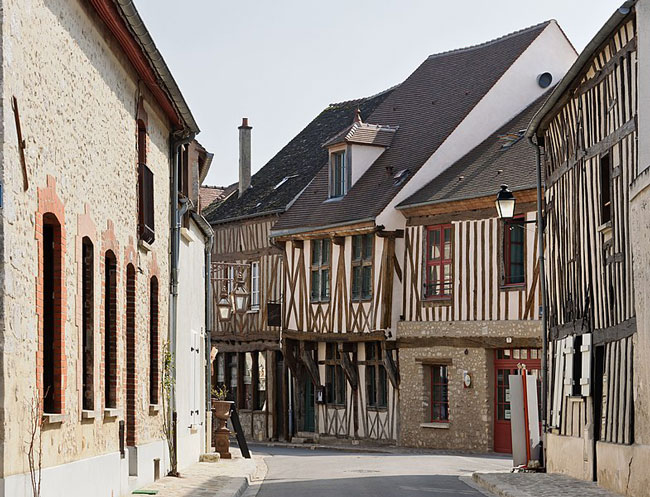

What do you think it would be like to live in a town where practically every house is over 500 years old? If you lived in Provins you would know exactly what it’s like. This near-perfectly preserved medieval town sits on the eastern edge of the Île de France where it meets the Champagne region. This year it’s celebrating the 20th anniversary of its recognition as a UNESCO World Heritage site with a full calendar of events. Visit and for a day you can step back in time to the 1300s and imagine life in the Middle Ages.
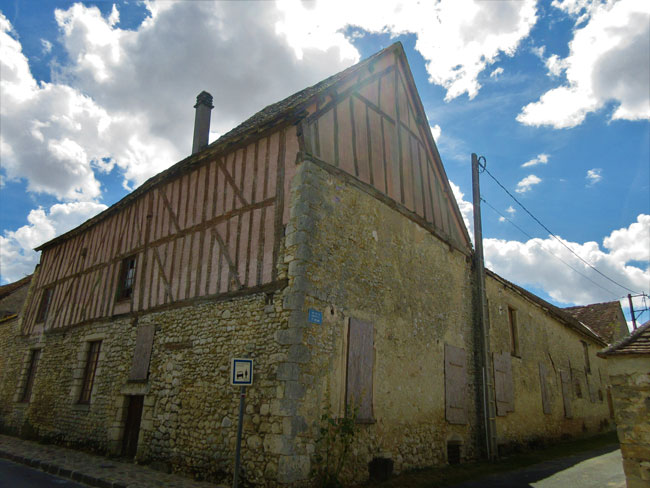
Half Timbered House in Provins. © Pat Hallam
Provins is easy to reach from Paris: direct trains on the regional Line P leave Gare de l’Est regularly. It is even on the edge of Zone 5 so if you have a 5-zone Navigo pass, the fare won’t cost you anything extra. It makes a perfect day trip from the capital.
Strolling into town from the train station, the streets are criss-crossed by a delightful small river, La Voulzie. Nowadays, it is literally a quiet backwater and the stream tumbles prettily over stones. It flows alongside the streets with small bridges crossing it to the houses, or else the houses are built right next to the water like a miniature Venice. But 700 years ago it provided Provins with a ready source of water for wool processing, the source of the town’s wealth.
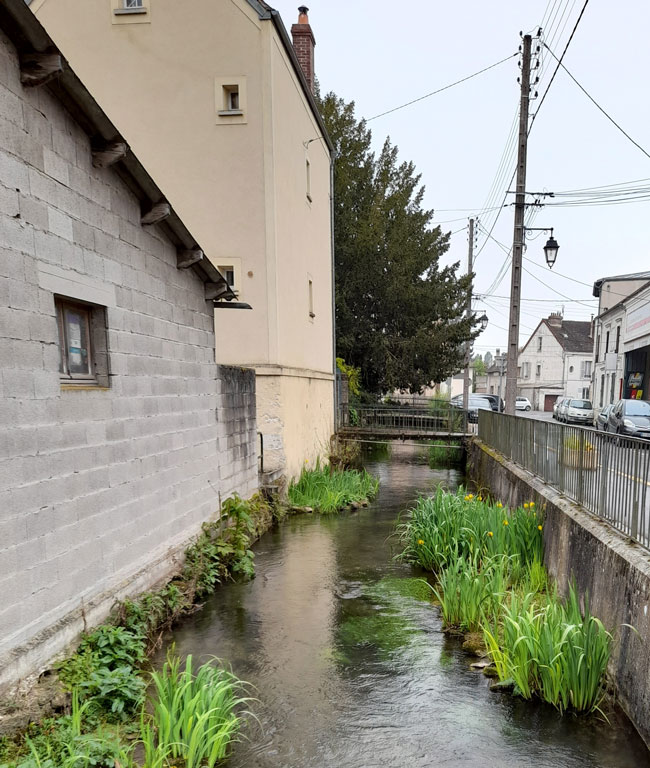
The River Voulzie. © Pat Hallam
Provins was made for exploring its narrow back streets and tiny alleys. It is split between the Lower Town and the Upper Town. Both are full of characteristically half-timbered buildings in the style called colombage in French, but it is the Upper Town that attracts most visitors. The road to the top is quite steep but in high season there is the obligatory tourist train to ease the journey.
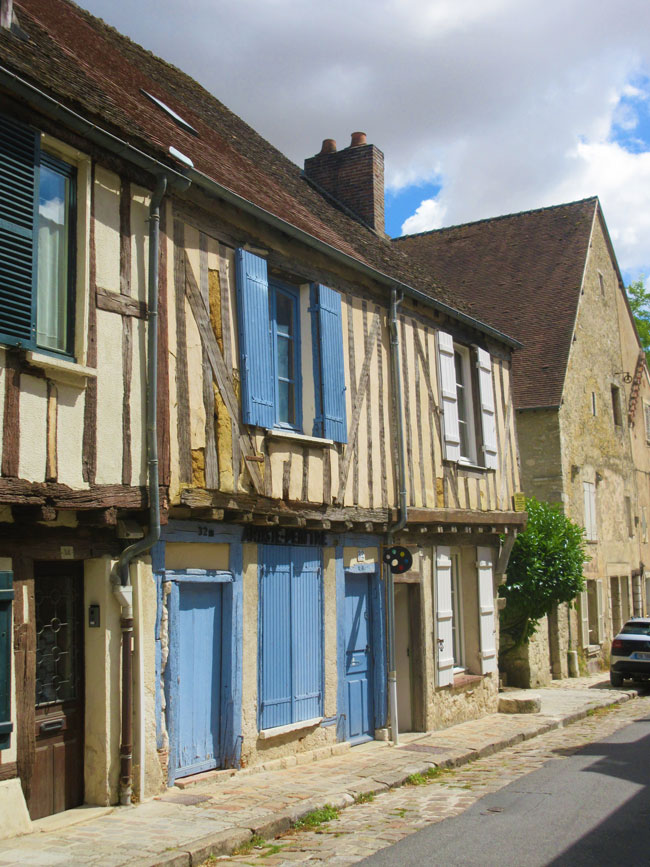
Medieval houses in Provins. © Pat Hallam
Once you’ve arrived, a walk along the 13th-century stone ramparts offers a stunning view of the surrounding countryside. They originally encircled the town for 5km and are in the process of being restored. Dramatic falconry shows demonstrate the skills that were essential for any young nobleman to possess at that time.
Or you could climb the Tour César, built between 1152-1181, less for practical defense than as a statement of the power of the Comtes de Champagne. As you climb, the steps become ever steeper and narrower but if you have the nerve you can actually step into the belltower (but don’t touch anything!).
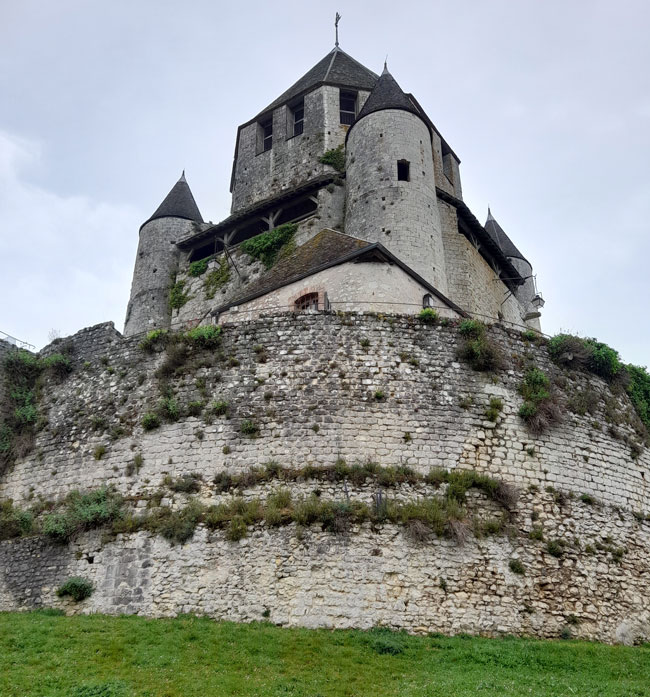
Tour César, 12th century, in Provins. © Pat Hallam
Walking around the Upper Town, you are faced at every turn with ancient houses and it is very easy to feel transported back half a millennium. One of the best-preserved examples is the Tithe Barn (Grange aux Dîmes), dating from the early 13th century and whose magnificent vaulted rooms are now a museum of Provins life in its heyday (a tithe was 10% of each peasant’s harvest given to the Church). Inside, shop and workshop reconstructions give an idea of the bustling town during the Champagne Fairs, which were very cosmopolitan for the time and enjoyed their greatest success between around 1120-1320.
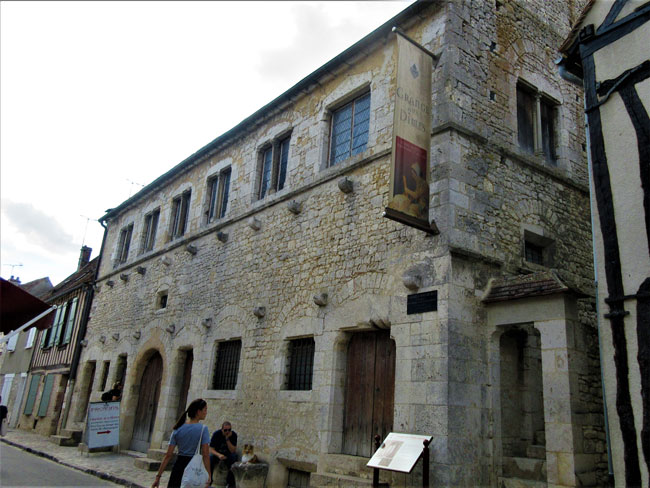
Tithe Barn in Provins. © Pat Hallam
It was these fairs which enabled Provins to develop into a major commercial center at the crossroads of trade routes from the Mediterranean, Northern Europe, and the Middle East. They had nothing to do with the famous sparkling wine. Rather, the wealth of the Champagne region depended on sheep rearing and the woolen industry. The Comtes de Champagne were a powerful dynasty, able to raise an army against the King of France when necessary and raising vast revenues from their rents and management of extensive swathes of countryside. For a while Provins was allowed to mint its own coinage, a sign of its importance.
The Champagne Fairs were a very visible sign of the counts’ power and attracted merchants, moneylenders and lawyers from Italy, Flanders and the Low Countries (modern Belgium and Netherlands), and what is now Germany. Not just French wool was traded: wine from Spain and Portugal; Russian leathers and furs; Eastern spices; minerals from Syria, and English wool all exchanged hands. In the museum you can see a microcosm of a typical fair with mock-ups of a moneylender’s office, a draper selling fine linen and a Flemish wool and fur merchant, as well as a public writer who would write contracts and statements for the illiterate businessman. In the cellar, workshop reconstructions show the ordinary residents of Provins plying their trades: spinning, stone-cutting, pottery.
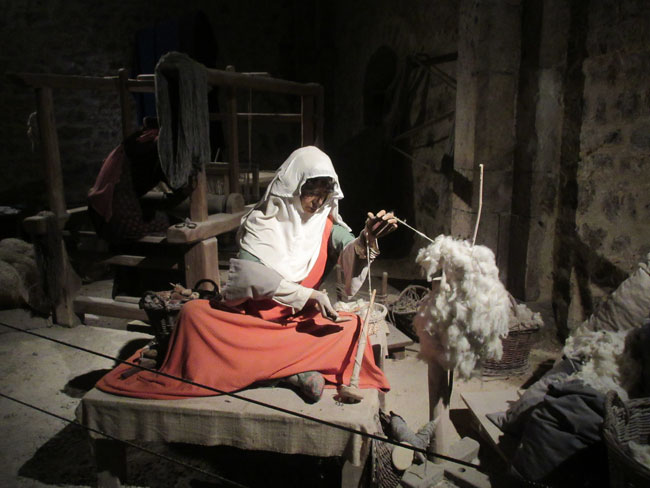
Spinning wool, an essential task for Provins women. © Pat Hallam
Nearby, the town museum is housed in the 12th-century Maison Romane, the oldest complete building in Provins alongside the Hôtel Dieu. If you need a pitstop by now, the Place du Châtel has a number of cafés and restaurants as well as a merry-go-round to keep the children amused.
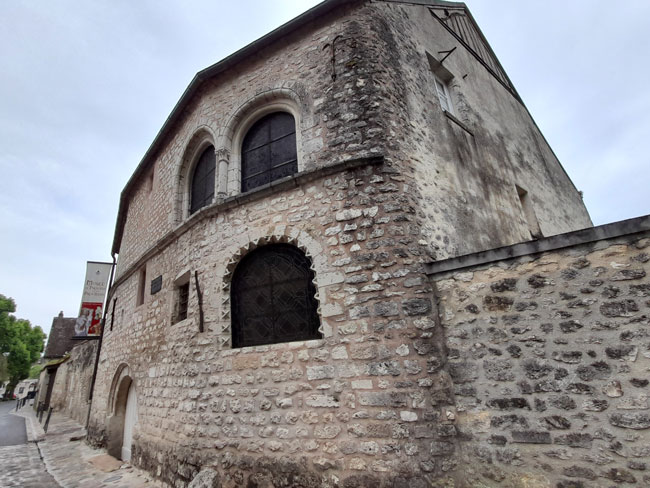
Maison Romane, 12th century, in Provins. © Pat Hallam
On the way back to the Lower Town, you pass the Hôtel Dieu. This hospital for the town’s poorest inhabitants opened way back in 1157, but it was already a palace belonging to the countesses of Blois and Champagne. It also served as a guest house for pilgrims who came to see the relics of St. Ayoul, and later, merchants visiting the fairs. The underground vaults are open to the public: once upon a time the fuller’s earth the hôtel is built on was extracted to degrease wool.
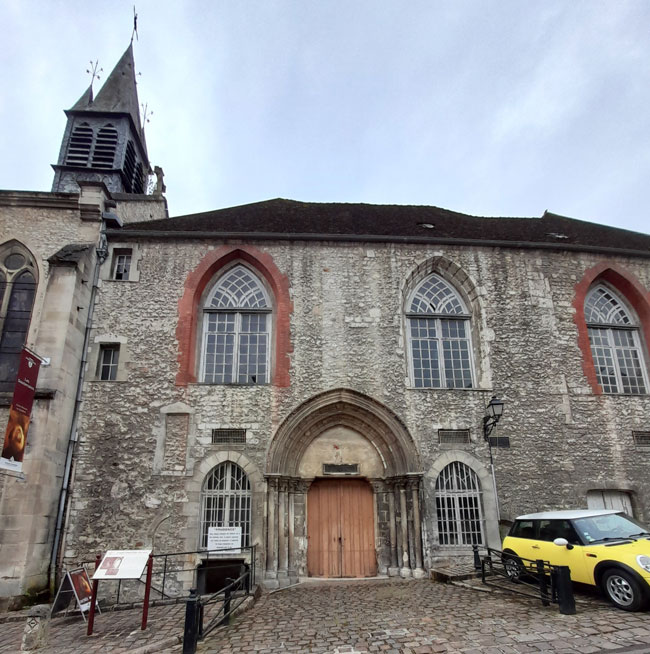
Hôtel Dieu, 12th century, in Provins. © Pat Hallam
Back in the Lower Town, the Benedictine Priory of Saint Ayoul hasn’t been restored so much as protected from the elements. It’s unusual to see old ruins roofed-over but when you step inside you understand why. The transept, built in the mid 1000s, still has full-height walls, which are not only still plastered, but also painted. Faded with age, certainly, but the yellow and pinky-red decoration on the columns and ceiling has survived amazingly well, and especially the wall fresco. The church of St. Ayoul attached to the priory was given to the parish in 1527 and is much plainer inside, even austere.
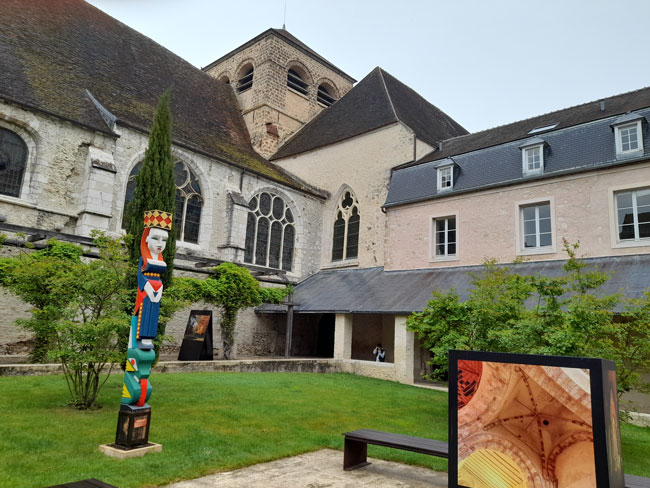
Cloister of the Priory of St Ayoul and the parish church. © Pat Hallam
A few minutes away, the Tour Notre Dame du Val straddling Rue Vieille Notre Dame is the last vestige of the ecclesiastical chapter of the same name. The chapter was abandoned after the Hundred Years War with England in the 15th century, but the bells in the tower are still rung on behalf of the church of St. Ayoul.
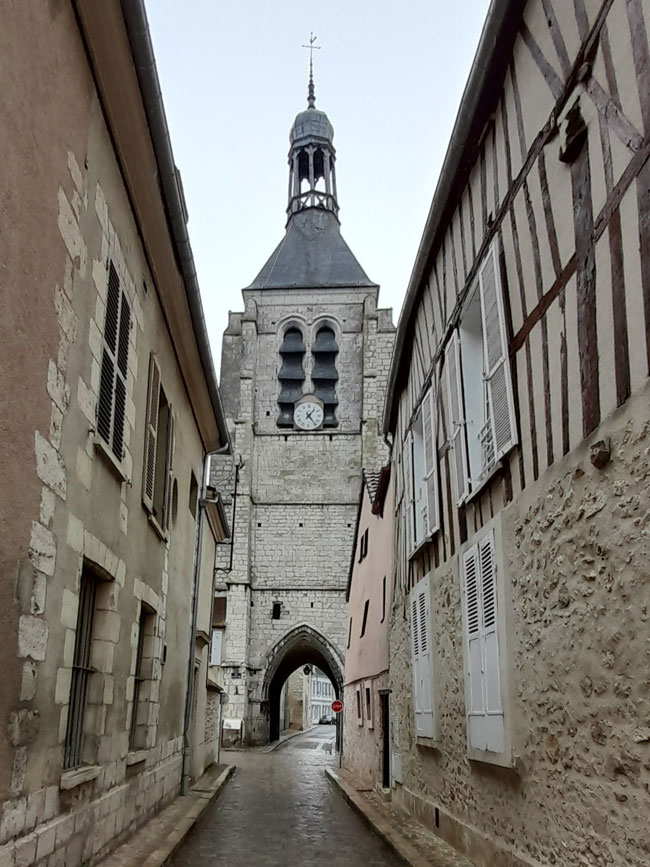
Tour Notre Dame du Val in Provins. © Pat Hallam
If, by now, you feel you have had enough of medieval life, La Roseraie is a delightful rose garden on the outskirts of town that will bring you back to the 21st century. It boasts over 1500 rose bushes including more than 300 varieties. In summer it is a riot of color and fragrance with formal beds alongside tree-shaded lawns and a stream running through the garden. A salon de thé and garden shop complete a visit.
In summer, the town presents a continuous program of events ranging from candlelight tours, a medieval fair and sound and light shows. Check www.provins.net for the latest information (in English and French). A Provins Pass can be bought at the tourist information office which gives access to all the main sites and lasts for a year. I would allow a full day to see everything but if you don’t manage it all in one visit, the pass gives you a good reason to come back. To be honest, if you are interested in the Middle Ages, you won’t need an excuse to return!
Lead photo credit : Half-timbered medieval houses in Provins. © Myrabella at Wikimedia Commons
Share to: Facebook Twitter LinkedIn Email
More in La Voulzie, Provins
Related Posts

By Pat Hallam
REPLY
REPLY
REPLY
REPLY