Paris in Color: A Guide to Colorful Venues in Winter
George Orwell remarks in his 1933 novel, Down and Out in Paris and London, that in Paris, “the sky was like a vast flat wall of cobalt, with roofs and spires of black paper pasted upon it.” Indeed, when Baron Haussmann redesigned Paris’ architecture in the mid-19th century, he was sure to adhere to a neutral-toned limestone aesthetic, with such design uniformity being upheld by the Architectes de Bâtiments de France to this day. While visiting Paris from December to February might be an ordeal of darker skies, woolen layers and bleak surroundings — it doesn’t have to be. Notoriously painted with a grey brush, Paris still houses pockets of exploding color between the black papier-mâché skies and bland building façades, waiting to be found by all those in search of the city’s unique vibrancy.
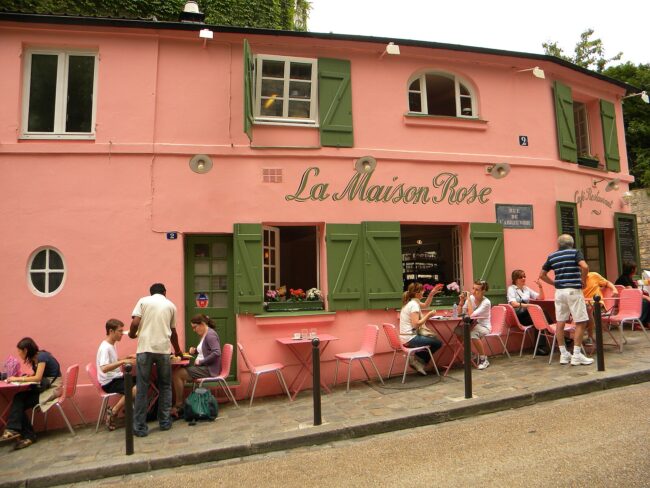
La Maison Rose in Rue de l’Abreuvoir, Butte Montmartre. Photo: Britchi Mirela / Wikimedia commons
La Maison Rose
Tucked away on the sloping rue de l’Abreuvoir in Montmartre, La Maison Rose is true to its name in its soft terracotta pink shade. The French restaurant began as a small house purchased by Ramon Pichot in 1905, who had hoped to turn the building into his own personal painting studio. Three years later, Pinchot’s newly married wife insisted that they paint the outside walls pink, transforming the venue into a rose-coloured restaurant that is instantly recognisable today. La Maison Rose has hosted notable names over the years, from artists such as Picasso and Albert Camus to performers Alain Delon and Dalida, also being featured in Netflix’s show Emily in Paris more recently.
Location: 2 Rue de l’Abreuvoir, 18th
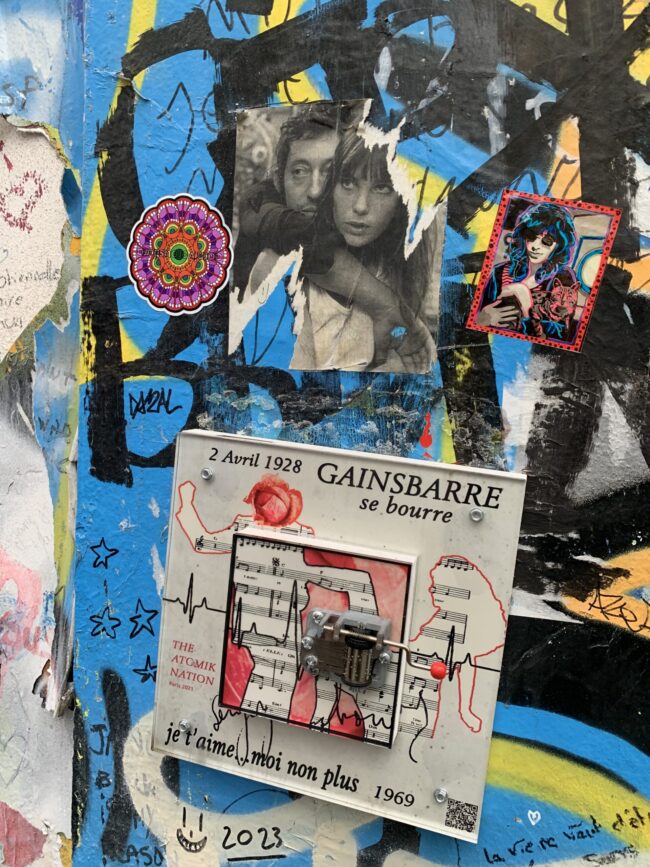
Maison Serge Gainsbourg. Photo: Sophie Farmer
Maison Gainsbourg
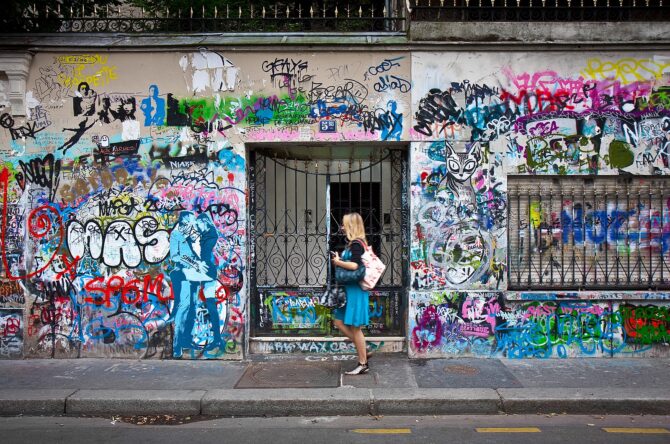
Having just finished Jane Birkin’s Munkey Diaries, it is clear how important Serge Gainsbourg’s property was in the lives of the Gainsbourg-Birkin family. A personal sanctuary, artist’s studio and even a “brothel” in Gainsbourg’s own jovial words, 5 bis (also referred to as “Rue de Verneuil” by Jane B) had many lives from 1969 until the couple’s separation in 1980, where Serge stayed on at his property until his death in 1991. Now a museum hosting tours to the general public, the venue remained untouched 32 years later in the hands of the couple’s daughter, Charlotte Gainsbourg.
Decorated with patches of graffiti outside the home, Gainsbourg-Birkin fans have given the entrance its own lick of color as an acting shrine, continuing to reinvent the property in the 21st century and to commemorate its former inhabitants. The historical landmark, with its colorful etchings, stands out against the muted bourgeois exteriors of the surrounding residences, much like the man himself who refused to conform or contain his outward artistic sensuality, which was not always well received during his fruitful career.
Location: 5 bis Rue de Verneuil, 7th
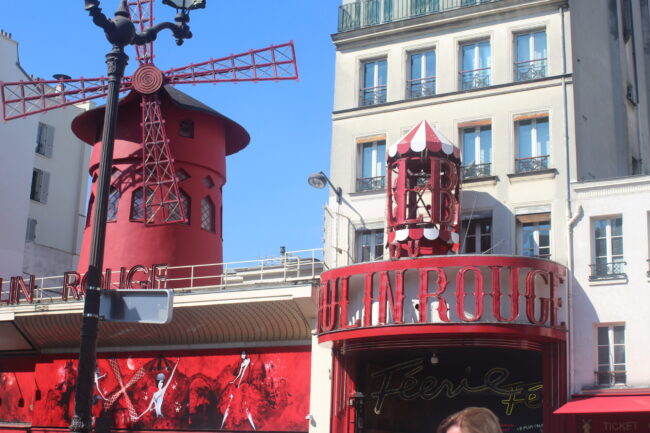
Moulin Rouge. Photo: Sophie Farmer
Moulin Rouge
With the tune of “Lady Marmalade” echoing in the background, the iconic Moulin Rouge must be included in this list, if not for its ruby red exterior, for its large Belle Epoque letters and experimental, as well as enduring, architectural design. The Moulin Rouge cabaret continues to draw audiences to the foot of Montmartre, more than a century after its opening (1889). Back in a time which suffered economic depression after the defeat of Napoleon, the Moulin Rouge provided respite from the ordinary, showcasing the art of exotic dance to spectators from all social classes.
And the color red? The color of excitement, passion and sensuality also pays homage to the region’s historic windmills (with “moulin rouge” translating to “red mill” in English), once a rural village with windmills dating back to 1622.
Location: 82 Bd de Clichy, 18th
La Diva des Prés
In the heart of the 6ème arrondissement, this fabulously lit-up bar serenades its passersby with glowing pink illuminations and eccentric floral displays. While less historic than other venues listed, it is just as eye-catching and charming with its camp decoration. On Instagram, boasting 29k followers, the venue celebrates its ‘pink mood’ which has become a defining characteristic, reflected in its pink cocktails and pink stencil designs on coffees alike.
Location: 79 Seine Street, 6th
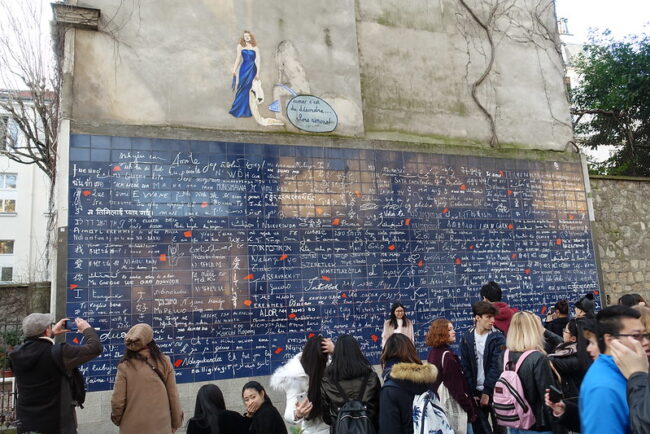
Mur des Je t’Aime. Photo: Guilhem Vellut / Flickr
The Wall of Love / I Love You Wall
Spanning 430 sq ft and consisting of 612 enameled lava tiles, this iconic mural depicts the theme of love in some 250 languages. “Je t’aime,” “σε αγαπώ”, “I love you” are just a few of the many languages on the wall of love, created by artists Frédéric Baron and Claire Kito in 2000. While stylized across a near Majorelle blue, splashes of red represent pieces of a broken heart, scattered amid the many “I love yous,” all united by one symbolic wall. Twenty-five years later, the work of art continues to attract tourists in their thousands, taking enjoyment as they attempt to spot their own language upon the fresco.
Location: Square Jehan Rictus, 14 Pl. des Abbesses, 18th
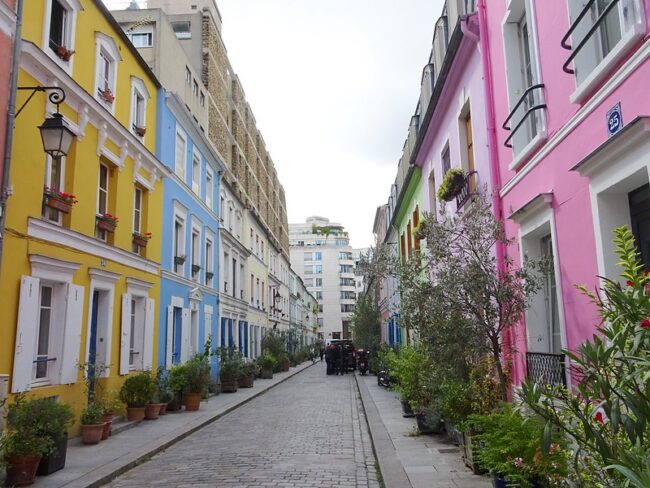
Rue Crémieux. Photo: Sharon VanderKaay/ Flickr
Rue Crémieux
Coined the “most colorful street in Paris,” Rue Crémieux is found in one of the less architecturally regulated areas (by Haussmann standards), where rows of pastel-painted houses stand proud in the 12th arrondissement. The colorful exteriors date back to 1993, when residents petitioned to pedestrianize the road and, upon approval, were asked to redecorate the front of their homes. Each homeowner agreed to paint their house a different pastel hue, which is how Rue Crémieux —in all its colors — came to be.
Location: Rue Crémieux, 12th
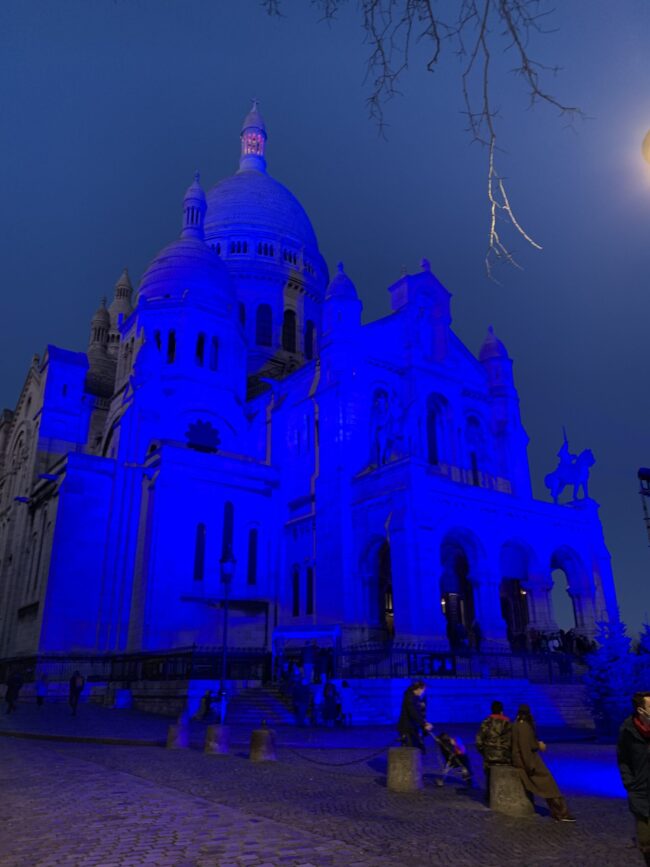
Sacré Cœur Basilica in January 2022. Photo: Sophie Farmer
Light Installations across Paris
While stylistic continuity and historical landmarks are respected across Paris, that does not mean that the city does not experiment with projecting color in non-permanent and innovative ways. Colored light installations appear for various reasons, be it social, political or cultural, and illuminate the city’s most famous spots to raise awareness.
The photo above depicts the Sacré Cœur Basilica in January 2022, lit up in blue along with other key monuments in the city for a week. The blue was inspired by France having been named the head of the Council of the European Union, emulating the blue of the EU flag.
As pictured below, the Eiffel Tower shone with a multitude of rainbow colors to honor the victims of the homophobic shooting in Orlando in June of 2016 and to show solidarity with the LGBTQ+ community. Projected across the iconic landmark: “#lovewins.”
And lastly, as the popular Wicked film came to the cinemas in November 2024, the Arc de Triomphe shone with the leading characters’ signature pink and green colors for all to see.
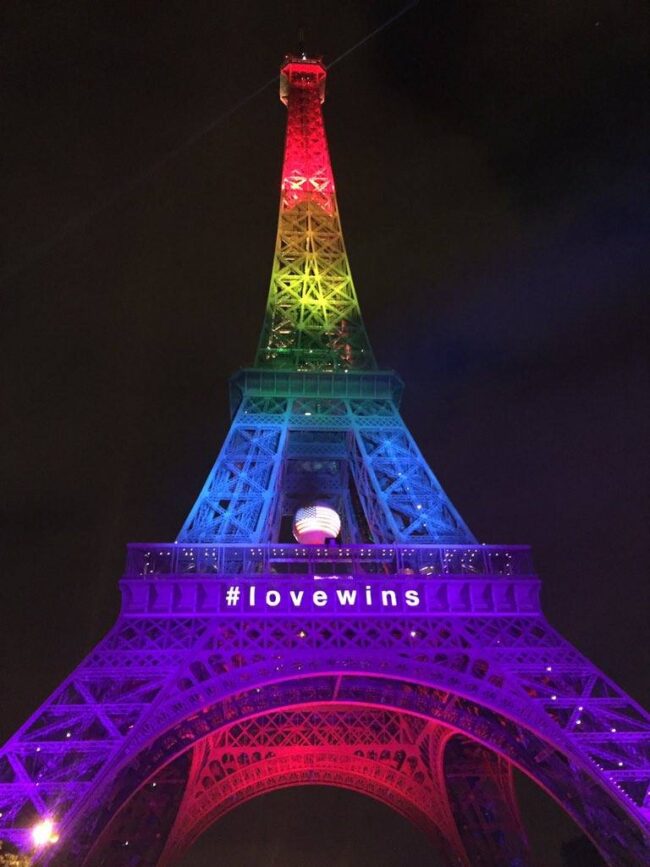
Eiffel Tower in June 2016. Photo: Ville de Paris/ Facebook
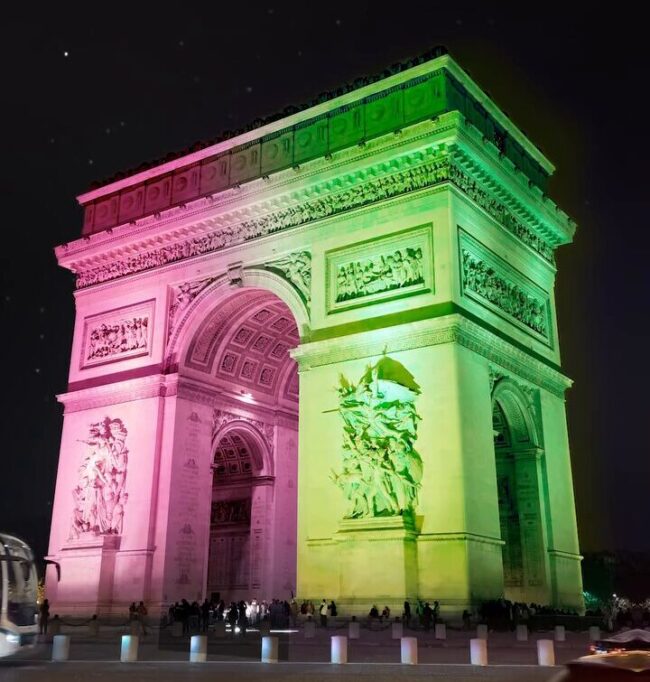
Photo Credit: Wicked news/ X
Lead photo credit : House of Serge Gainsbourg, Rue de Verneuil. Photo: Nate Bolt /Wikimedia commons
Share to: Facebook Twitter LinkedIn Email
More in Paris in color, winter in Paris
Related Posts