The Grand Rex: The Pride of the Grand Boulevards in Paris
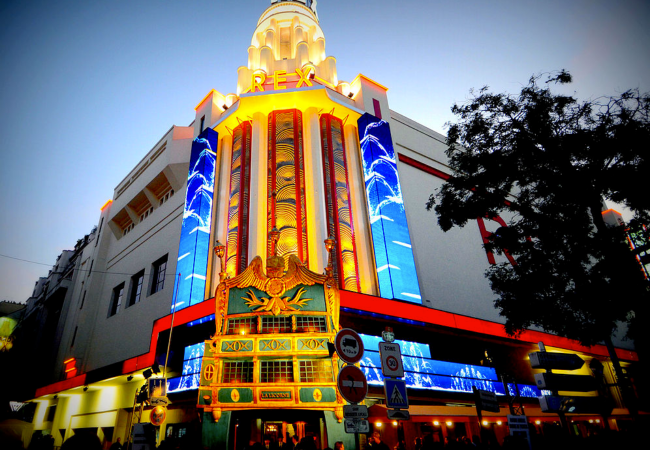
One of my favorite areas in Paris is the Grands Boulevards, which most tourists know mostly because of the big department stores, Galeries Lafayette and Printemps, that are located there. But the quartier is also a center for theaters and concert halls, and the nightspots that cater to their clientele. So if it’s like what the British call the “high streets”, it also evokes London’s West End and the theater district in New York. The most famous venue here is the Grand Rex, which in December celebrated its 90th anniversary. What started as a cinema has become an entertainment complex with a dizzying array of attractions, sometimes with a kitschy vibe, but genuinely dazzling.
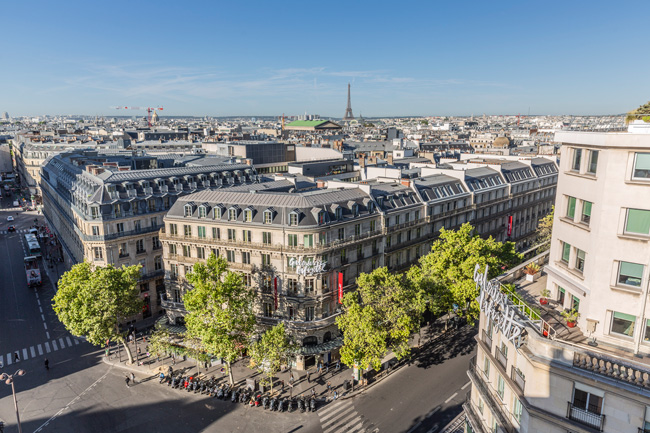
Galeries Lafayette Terrace, courtesy of Galeries Lafayette Paris Haussmann
The Grand Rex is first, a movie palace, built in 1932 (it’s been classified by France’s Culture Ministry as an official historical monument since 1981). There are few of these gaudy palaces left: the Kinopanorama was demolished long ago, while the Louxor was closed for years, before recently reopening. With the largest screen in Europe (aside from Imax) the Grand Rex is the place to see an especially spectacular film — currently on the bill is (what else?) the latest Avatar incarnation (coming soon: Babylon). I’m speaking of the “grande salle” (capacity 2,700) — in addition to its huge screen, the Rex is also a multiplex with six smaller rooms and screens, usually showing popcorn fare. (M3GAN anyone?)
A passion to impress the public has been the Rex’s central principle from the beginning. Like other edifices of the time, it relied on the Art Deco style and Oriental and ancient motifs to leaven its gigantism. Even the human dimension was superhuman, with full-scale orchestras, troupes of ballet and tap dancers, an enormous subterranean organ. The theater also had its own police station, hospital, nursery, and even kennel.
The Grand Rex has also had its share of ups and downs. The original owner, Jacques Haïk, who was often unbending in his extravagant demands for the theater, went bankrupt. The group that took over the theater also wound up reselling, to the Gaumont film company. During WWII, the Rex was seized by the Nazis, and turned into a Soldatenkino, an entertainment center for occupation troops. With the Liberation came an influx of films from Hollywood.
View this post on Instagram
Its near century-long history of spectacle included sneak previews, often with big stars and film crews presenting their movies. Christmastime fare was the latest Disney extravaganza, going all the way back to the animated Pinocchio. When Cinemascope came along, the Grand Rex had to have the new format, and inaugurated it with the Biblical epic The Robe.
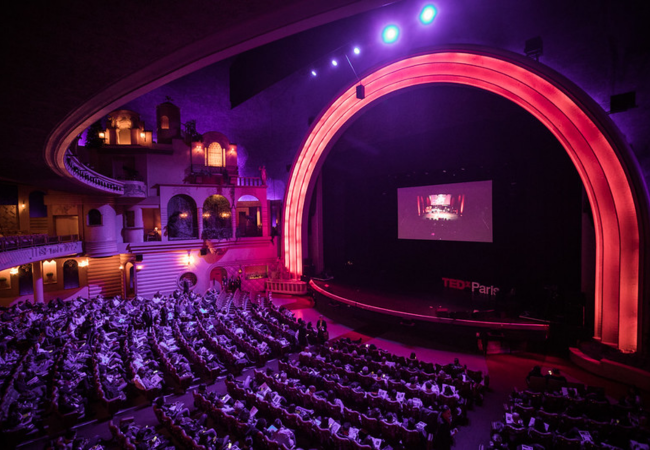
“TEDxParis 2017, le 6 novembre au GRAND REX par Brightness”. Credit: Tedxparis /Wikimedia/ licensed under CC BY 2.0.
Traditionally the movie was the culmination of a packed program that included musicians, dancers, newsreels, and sumptuous attractions such as simulated waterfalls and volcanoes. While this sort of program is long-gone, the Grand Rex remains an important venue for live shows of every type. Live concerts, music-and-film hybrids (“ciné-concerts”), comedy shows, currently even a lecture series on wellness by a celebrity “mystic” doctor. Madonna has appeared here, as has Britney Spears.
This autumn I saw Bob Dylan in concert, and discovered an original policy regarding phones: The public had to turn off their phone, place it in a bag locked with a magnetic device. (After the concert the bag was unlocked.) Whether this will become standard policy remains to be seen. Apparently it was specially required by Mr. Bob.
View this post on Instagram
The Grand Rex also puts on “Special Events” of various sorts. The Ecran Pop (literally Pop Screens) evenings are built around classic musicals like Grease, Mama Mia!, Dirty Dancing, West Side Story. There’s the Sailorz Film Festival — the only film festival dedicated to (get ready) films about sailing. Sometimes the theater organizes binge-watching “Marathons” of franchises such as Star Wars. For fans of football (the American kind, not soccer) there will be a live showing of the Super Bowl, and an evening of accompanying attractions (shows, quizzes, special guests, snacks and drinks, and “surprises”). Also scheduled is a glitzy premiere-style sneak preview of Damien Chazelle’s Babylon.
View this post on Instagram
Throughout its history, the Grand Rex seemed to stress state-of-the-art technology and lavish infrastructure even more than the “content” of movies and shows, beginning with the huge screens and immense seating areas. It was the first cinema to offer mechanical escalators to go from one level to another. Dedicated generators guaranteed power for the attractions during energy crises (we can all identify with that today). Other features included digital signage, Dolby/Digital Theater Systems stereophonic sound, an illuminated decorative arch, and an oversized, but still moveable, stage. During the Covid period, when cinemas were off-bounds, the Grand Rex undertook a complete renovation, which was recently completed.
Rex Studios, the theater’s museum, offers a fascinating guided tour focusing on the art deco architecture, décor, the latest technology, and its super-sized screen. Alas, there are apparently only French-speaking guides, though audio-guide headsets are available. (In a perverse way, the Grand Rex’s francocentricity is part of its charm.) There’s a slightly more expensive interactive backstage tour meant to be educational as well as entertaining. The latter has a number of fun-for-the-kiddies activities. (I have fond memories of taking my own children there way back when.) Aside from the Rex’s backstage are reconstructions of a movie set, director’s office, projection booth, special effects demo.
What else? An escape game: Called “Save the Cinema”, the game centers on a mysterious machine in the Rex which is making off with classic films. Participants must get to the bottom of it, navigating six FX-laden rooms. A gift boutique: At the Rex Boutique, accessible online, you can buy an array of gift-shop products, from traditional swag such as commemorative coins, magnet Oscars, tote-bags and mugs, to electronic gift certificates.
A nightclub: The music featured at the Rex Club has changed over the years. It was disco at one time, but nowadays the basement club is mostly dedicated to electronic dance music. The club even has its own house magazine, Rexorama, featuring profiles of musicians.
A light-and-water show: Periodically (typically during the Christmas season) a spectacular show called La Féerie des Eaux (literally “Water Fairyland”) is held, featuring an enormous pool and 1,200 water-jets.
If anyplace in Paris lives up to William Blake’s adage that the proper definition of “enough” is “too much”, it’s the Grand Rex.
DETAILS
The Grand Rex
1 rue Poissonnière, 2nd arrondissement
Metro: Bonne Nouvelle
Lead photo credit : Le Grand Rex Facade by A.hellmann on Wikimedia Commons
Share to: Facebook Twitter LinkedIn Email
More in cinema, entertainment, grand rex, history
Related Posts