Film Review: Le Règne Animal
It’s a cliché that French filmmakers don’t do fantasy very well. Sure, there are the super-stylized films of Besson (Subway), Jeunet and Caro (Delicatessen), and Beneix (Diva), that come close to fantasy, but aren’t the real (that is, invented) thing. That makes it even more surprising that Thomas Caillet’s Le Règne Animal (Animal Kingdom) is one of the best French films of this year, and certainly the most original. If there were ever a French pop movie that deserves international success, this is it, as its story speaks to all of us at this particular moment.
The premise is simple, though mysterious. An “accident” has taken place — we’re never told what, exactly. Nuclear radiation leak? Chemical toxin release? Biological contamination from some lab? Part of us wants to know precisely what, but the mystery keeps us wondering, and imagining different scenarios. (Just like with Jordan Peele’s Us.) The accident causes people to become sick: in fact to mutate partly or wholly into animals. There are treatments for the “sickness” but they don’t seem to work well. The unfortunates are referred to as “creatures” by those who sympathize, and by those who don’t as “vermin”.

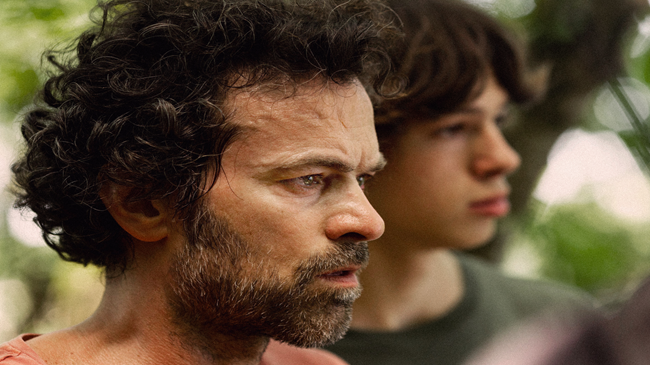
One such creature is Lana, the wife of François, intensely played by Romain Duris. We first meet him and his son Emile (Paul Kircher) when they’re caught in a nightmarish gridlock in the city, something out of Godard’s Weekend. It’s a vision of “civilized” life at its most hellish, and at one moment Emile jumps from the car and runs away through the traffic jam. François gives chase until they both witness a winged creature hunted down by the authorities. We also catch glimpses of other creatures — the movie has echoes of kindred fantasy visions and initially there’s a strong whiff of David Cronenberg.
A doctor orders the family to go to a holiday town in the boonies (actually in lovely Gironde, in the south of France) for a month or two. Why isn’t really clear. Apparently there’s a center for detained creatures there. François rents a rustic cottage and gets a job as a cook, but Lana, who’s mutating into a sort of oversized nutria or giant gopher, escapes into the wild, which seems rather idyllic. The putative plot of the film concerns François’ search for his wife in this area infested with creatures.
Duris brings the feral electricity of a young Harvey Keitel to the role of the husband-father, and provides much of Le Règne Animal’s energy. He’s also engagingly emotional (a Keitel with heart). But gradually it’s Paul Kircher’s brilliant performance as Emile that gathers power and attracts our interest and concern. The 21-year-old first made his mark in last year’s Le Lycéen, for which he won an award at the Saint-Sébastien film festival and was nominated for a César.

Still from Le Règne Animal. Credit: Nord-Ouest Films/ Studio Canal/France 2 Cinema/ Artémis Productions
The plot branches out into teen drama: Emile’s budding romance with a classmate and up-and-down relations with other young people. This would be terribly banal if it weren’t for the radical changes happening in his body. It’s rather like-mother-like-son (though the more hirsute changes remind us of papa François). Even that might be banal if not for Emile’s emotional distress, which recalls the angst felt by all teens— but multiplied exponentially. (It’s like the novel Middlesex, which wasn’t so much about hermaphroditism as the changes wrought by adolescence.) Sometimes the agonized performance is too much, evoking Lon Chaney Jr (aka the Wolfman, another cinematic echo).
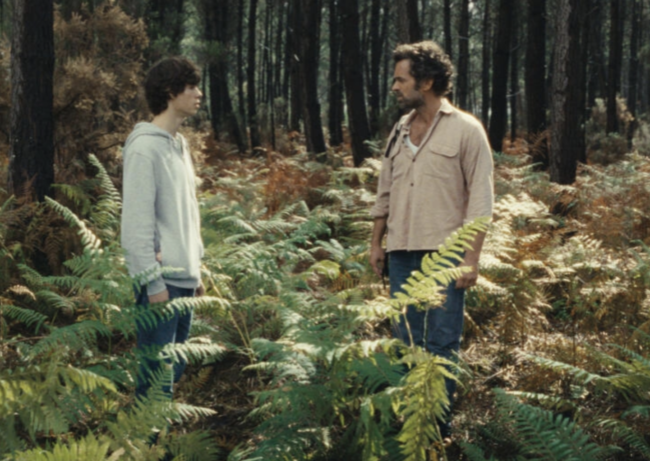
The spectacular locale of the film is more than a rustified resort. It makes us think of The Island of Lost Souls, where humans were grafted with animal parts. The high-tech FX versions of the creatures seem somewhat derivative of the low-tech make-up of the 1932 film. The place makes for the perfect spooky setting. But it also becomes like Shakespeare’s Arden Forest, a natural but magical place where anything can happen, good, bad and in between.
One of those things is François meeting a woman gendarme named Julia (Adele Exarchopoulos). Ms. Exarchopoulos’ looks are tamped down by her uniform and official role — her charismatic presence comes out more in her brandy-soaked alto voice. There should be emotional sparks, but because François is so faithful to his wife (even if she’s now a huge ruminant) we just get a soulful mind-meld instead. Ms. Exarchopoulos’ talents are mostly wasted — this is basically a guest star turn for her. Still, she helps move the plot along and also serves as graceful ballast for François’ hyped-up frenzy.
Still from Le règne animal. Credit: STUDIOCANAL / France 2 Cinéma / Artemis production
There are echoes not only of films in Le Règne Animal, but of real-life phenomena. The fable about “creatures” (or “vermin”) may allude to sex-and-gender bending; to transhumanism, from bioengineered genomes to cyborg-like implants and prostheses; to people altered by disease and chemicals. It also obviously refers to animal rights and species-ism. Our mutating youth may not be all that different from the boy with green hair in Joseph Losey’s classic film of that name.
While the film is thematically rich and intriguing, the above may make it sound heavier than it is. The director also happens to be a gleefully shameless recycler of horror/sci-fi techniques. Jump shocks and creepy reveals abound, and there’s even a slapstick scene with the winged mutant that’s reminiscent of Nicolas Cage in Birdy. I’d love to call Le Règne Animal a little jewel of a movie, and it comes close, but it’s unfortunately overlong. Some might also criticize the film for pushing its theses too far. I may have been in that frame of mind myself, but as I entered my building’s courtyard after watching the film, I saw a strange rodent whizz by with preternatural speed, reality in search of a fantasy film. In these odd times we live in, it’s sometimes hard to separate the two.
Production: Nord-Ouest Films/Studiocanal
Distribution: Studiocanal
Lead photo credit : Photo: Ivan Mathié Nord-Ouest Films Studio Canal France 2 Cinema Artémis Productions
Share to: Facebook Twitter LinkedIn Email
More in Animal Kingdom, cinema, film review, movie, Thomas Caillet
Related Posts