Film Review: Cédric Kahn’s “Making Of”

Director Cédric Kahn is something of a French Sidney Lumet. His projects vary from film to film, making his career interesting to follow but also leading one to suspect that he doesn’t have a unified vision of things. His last film, Le Procès Goldman (The Goldman Case), was a tough period courtroom drama. Making Of is contemporary, about movie-making and relationships. It’s in a mode that’s more ironic than comic, with skewed, often exaggerated, dramatic situations. In practice this means that half the audience (including yours truly) laughs frequently throughout the film, while the other half takes it as straight-on drama.
Denis Podalydés plays a director, Simon, making a film about a workers revolt that happened at a factory in a gritty provincial area. The revolt was more about control over the workplace (autogestion, a notion in vogue in the ‘70s), than a regular strike. One irony is that the production itself is having dire problems with the money men (and women). It’s the proverbial case of the powers-that-be demanding a happy end — to be uplifting and leave the audience with a warm feel-good sensation so that word-of-mouth brings in more customers. But Simon insists on his screenplay and the reality of what actually happened. To keep a trace of negotiations, not only financial but legal, he decides to have a “making-of” documentary made of the production, including sensitive meetings.

Cédric Kahn at la Cinémathèque française in September 2023. Photo credit: ManoSolo13241324/ Wikimedia commons
Like Lumet, Kahn has a strong feeling for social context and the cutting edge of history. His last film depicted the way radical politics in France took a rocky road to obsolescence via criminal violence. (Just as Lumet’s Serpico showed how the recreational drug economy corrupted New York’s police to the very marrow.) In Making Of we observe the grim shape of once-industrialized areas where workers are eager, even desperate, for jobs as extras in the film recording their own downfall. It’s a young local man unhappy with his lot and interested in a movie career who gets a big break when he’s recruited by Simon to shoot the making-of documentary.
Kahn also has a firm, maybe cynical, sense of conventional story-telling, including those happy ends. The making-it story of Joseph (Stefan Crepon), who shoots the making-of, goes hand in hand with his romance with Nadia (Souheila Yacoub), a young actress (in oldspeak: “ingénue”) whose part in the film is her personal break-out. They make an attractive, vivacious couple to satisfy the junior demographic as well as the awww contingent of the oldies. If not entirely cynical, the director, faced with a choice of savvy and proud, invariably chooses the yellow-brick box-office road (Making Of is a smash in France).
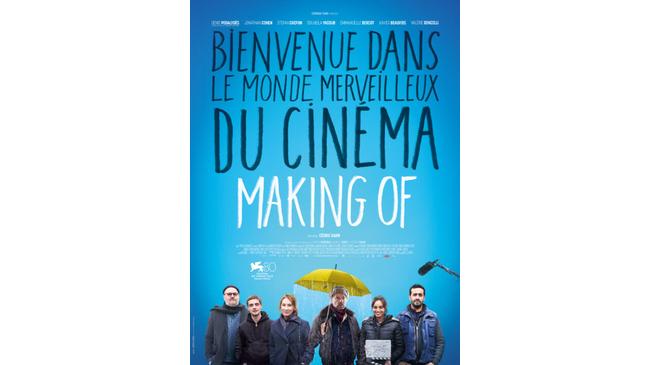
Poster for the 2023 film “Making of.”
Our fictional director Simon also has domestic problems: looming separation from his wife and the threat of estrangement from his children. Denis Podalydés has long been one of the French cinema’s most renowned actors. Often that status leads to easy and safe prestige supporting roles, especially as the actor ages. I’ve gotten used to seeing him as a name and face in big-budget movies. Here Podalydés makes a stunning return to movie-star form as his character navigates not only artistic reefs but also the perilous intersection of career and family. This is further entangled by our virtual tech age: his contact with wife and kids is exclusively via screens.
Valérie Donzelli is moving as Simon’s wife, especially considering that her presence is limited to screen time. The other female lead is Emmanuelle Bercot, who delivers a superb performance as Viviane, Simon’s tough-minded production director. She’s his main general on the financial front, facing off against a feckless producer while bucking up morale among cast and crew. The producer, Marquez, is played with convincing smarminess by Xavier Beauvois. The array of financial baddies is deliciously corrupt, though they seem more suitable for some Netflix series.

Still from “Making Of.” Curiosa Films
The biggest counterweight to Simon is Jonathan Cohen as Alain, the (fictional) movie’s star, who lends even more loopy irony to the (real) movie. Alain is a preening, self-absorbed film star who bends the workers’ story into a personal paean to his own acting glory, turning off numerous others on the set. Yet it’s he who insists on not giving in to the demands of the money men, even while he works (or so he says) at union scale. We’re treated to the paradox of a millionaire being featured in a “people’s film” in order to attract “the people” (i.e. ticket-buying fans) and coincidentally make a pile of coin.
Kahn juggles the subplots ably, revs up the tension, and successfully brings together the various strands of the film. His direction never falters, while the acting remains at a high pitch. The story of the production of the film about downtrodden workers comes increasingly close to the subject of the film itself. As in the fictional film-within-the-film, the overall arc risks turning into a downer. However, Kahn doesn’t just reach for a crowd-pleasing end, but in an already very ironic film pulls off a supremely ironic climax that shows that capitalism can work in mysterious ways. Part of the film’s profundity is that this seems both arbitrary and inevitable. That the real film was backed by an impressive battery of very established institutions and money men, and has gone on to make oodles of box-office cash, only adds another level of irony.
Production: Curiosa Films/Tropdebonheur Productions/France 2 Cinéma/UMedia
Distribution: Ad Vitam
Lead photo credit : Still from "Making Of." Curiosa Films
Share to: Facebook Twitter LinkedIn Email
More in cinema, film review
Related Posts